
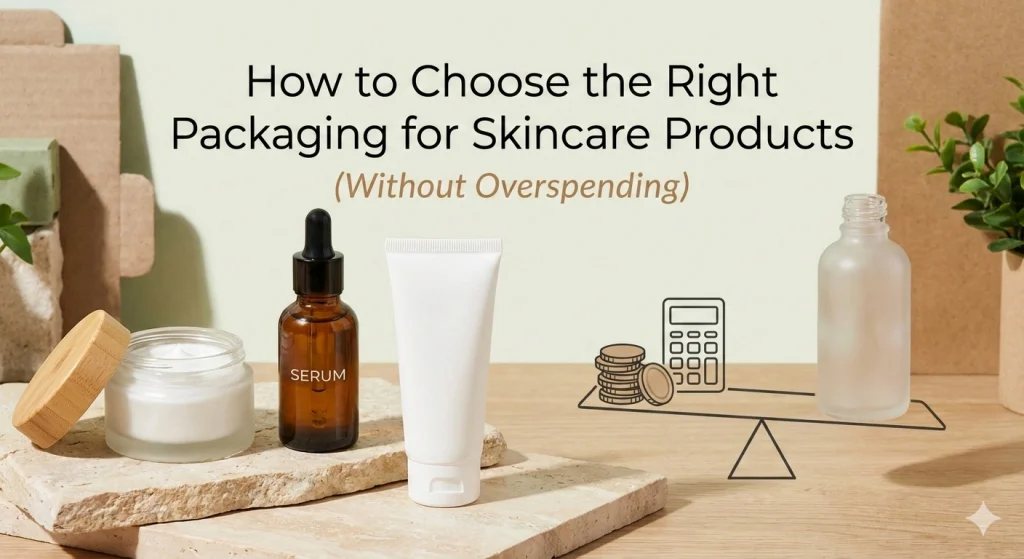
How to Choose the Right Packaging for Skincare Products (Without Overspending)
If you’re a skincare founder staring at packaging samples, comparing quotes, and wondering whether you’re about to make an expensive mistake, you’re not alone. Packaging decisions feel heavy because they are. Choose wrong, and you’re looking at leakage complaints, damaged shipments, or thousands spent on boxes sitting in your storage room because you over-customised too early.
The fear is real. Will this bottle leak during courier transit from Mumbai to Manipur? Is glass actually better than plastic, or is that just what the vendor sells? Should you invest in rigid boxes when you’re only doing 200 units a month? These questions don’t have simple yes-or-no answers, and that’s exactly why they create anxiety.
Here’s what you need to know upfront: feeling confused about packaging materials, costs, and choices doesn’t mean you’re doing something wrong. It means you’re taking it seriously. This guide won’t sell you anything. Instead, it walks through a practical framework to help you choose packaging that protects your product, survives Indian courier networks, and doesn’t drain your working capital before you’ve scaled.
Why Skincare Packaging Decisions Feel So Confusing
The packaging industry operates differently than most founders expect. When you reach out to vendors, you’ll quickly notice that everyone has strong opinions about what you should use, and those opinions often conflict.
One vendor insists glass is the only option for serums. Another says HDPE plastic is perfectly fine and costs a fraction of the price. A third suggests airless pumps, which sound premium but come with MOQs you’re not ready for. Meanwhile, you’re reading blog posts written for US or European brands, where shipping distances, climate conditions, and cost structures are completely different from India.
This creates confusion on multiple levels. You’re comparing materials you don’t fully understand, from vendors who manufacture specific types of packaging and naturally recommend what they stock. You’re trying to apply advice written for different markets. And underneath it all is the fear that one wrong choice locks you into months of inventory you can’t use or leads to product returns that damage your brand reputation.
The truth is simpler than it seems: packaging confusion isn’t a sign you need to become a materials expert overnight. It’s a sign you need clarity on what problem you’re actually solving. Most founders approach packaging as a branding decision when it’s fundamentally an operations decision first.
The Real Purpose of Skincare Packaging (Often Overlooked)
Before comparing glass versus plastic or debating matte versus glossy finishes, step back and ask what packaging actually needs to do for your business right now.
Packaging protects your formulation from contamination, light exposure, and air contact, depending on what your product chemistry requires. A vitamin C serum behaves differently from a shea butter body cream. Your packaging choice should reflect that behaviour, not just mirror what other brands in your category are using.
Packaging survives courier handling across Indian logistics networks. Your shipment might travel from your facility in Mumbai through multiple sorting centres to reach customers in tier-two and tier-three cities. Bubble wrap helps, but if your primary container isn’t suited to the product or your secondary packaging doesn’t cushion properly, you’ll see breakage and leakage regardless of how careful you are with packing.
Packaging builds customer trust through consistency and perceived care. When someone receives your product, the unboxing experience signals whether you’re a professional operation or still figuring things out. This doesn’t mean you need luxury packaging at the start. It means your packaging should look intentional and appropriate for what you’re selling and at what price point.
Packaging affects your operational flow in ways that aren’t obvious until you scale. Can you reorder the same boxes easily? Do your label sheets print consistently? When you add a new product variant, does it fit your existing packaging approach, or do you need entirely new setups?
Here’s the insight that changes how founders think about packaging: packaging is an operations decision first, branding decision second. Once you see it this way, many choices become clearer. You’re not asking what looks best. You’re asking what works reliably at your current volume and budget.
Common Overspending Traps Skincare Brands Fall Into
Choosing Premium Materials Too Early
Glass bottles feel premium, and for certain products like facial oils or high-end serums, they make sense. But many founders choose glass when plastic would work perfectly well because they assume customers equate glass with quality.
The reality is more nuanced. HDPE and PET plastics are chemically stable for most skincare formulations, significantly lighter for shipping, unbreakable during transit, and available at price points that make sense when you’re doing 500 units per month. Choosing glass at low volumes often means paying three to five times more per unit for containers, higher shipping weights that increase courier costs, and greater breakage risk that leads to refunds and replacements.
The same logic applies to secondary packaging. Rigid boxes with magnetic closures look beautiful, but if you’re selling a daily-use face wash at ₹450, that rigid box adds cost without changing the customer’s perception of value proportionally. Premium materials earn their place when the product positioning, price point, and purchase occasion justify them. For most early-stage brands, they don’t.
Over-Customization at Low Volumes
Customization feels like differentiation, so founders often rush into it before their operations are ready. They create three different carton sizes for three product variants. They add foiling, embossing, or multi-coloured printing to boxes. They design unique shapes that require custom moulds.
Each of these choices locks in costs and complexity. Multiple box sizes mean multiple MOQs to meet, more inventory to manage, and higher storage costs. Custom printing means you can’t pivot quickly if you need to update ingredients, change your brand name, or adjust product descriptions. Special finishes increase per-unit costs and often come with quality consistency issues that create stress during production runs.
The smarter approach early on is controlled flexibility. Use standard box sizes across multiple products where possible. Print brand elements on labels that you can update easily, rather than directly on cartons. Save customization budget for elements that customers interact with directly, like the primary container and label design, rather than spreading it thin across every component.
Ignoring Repeat Order Economics
Founders often optimize for the cost of their first order without thinking about reorder costs over time. A vendor offers a great price on 1,000 printed cartons, so you go for it. Three months later, you need to reorder, but now you want to tweak the design. The vendor requires a new set of printing plates. Suddenly, your “cheap” first order has become expensive on a lifecycle basis.
Lifecycle cost thinking asks different questions. Can you reorder this exact same packaging setup in six months without design or tooling fees? If you grow from 500 units to 2,000 units monthly, does this packaging scale smoothly, or will you need to restart from scratch? When you add a new product to your line, can it use compatible packaging components, or does each SKU require entirely new vendor relationships?
Optimizing for repeatability and scalability early often means slightly higher upfront costs but dramatically lower costs as you grow. It’s the difference between spending ₹45 per unit on packaging you can scale versus ₹32 per unit on packaging you’ll outgrow in four months and need to replace entirely.
A Practical Framework to Choose the Right Packaging
Step 1: Understand Your Product Behaviour
Start with your formulation. Is it water-based, oil-based, or anhydrous? Does it contain actives that degrade with light or air exposure? Is the texture liquid, cream, or solid?
A lightweight facial mist needs a fine-mist spray pump and doesn’t require heavy UV protection. A retinol serum benefits from opaque or amber containers that block light. A thick body butter can sit happily in a jar without airless pump technology. Matching container functionality to product behaviour eliminates half the decision complexity right away.
Step 2: Understand Your Shipping Reality
Think through your distribution model honestly. Are you shipping nationally through standard courier services, or mostly delivering locally? Do your products travel in summer heat across multiple states, or are they climate-controlled throughout transit?
If you’re shipping nationally via Delhivery, Bluedart, or Ecom Express, your packaging needs to withstand rough handling, stacking weight, and temperature variations. This might mean choosing slightly thicker plastic containers, adding inner cushioning, or using corrugated outer boxes instead of just bubble mailers for certain product types. If you’re primarily doing local deliveries in your city, you have more flexibility.
Step 3: Choose Materials Based on Risk, Not Aesthetics
Once you understand product behaviour and shipping reality, material choice becomes a risk assessment rather than a branding exercise.
For water-based lotions and creams at accessible price points, HDPE or PET plastic containers work well, cost less, and reduce breakage risk. For premium facial oils or products with sensitive active ingredients, glass makes sense despite the higher cost because it signals quality appropriately and offers better chemical stability.
For secondary packaging, evaluate whether you need printed cartons at all in the first phase. Plain kraft or white boxes with well-designed labels applied externally give you flexibility to update copy, change designs, and manage smaller inventory runs. You can always upgrade to printed cartons once volumes justify the MOQs and setup costs.
Step 4: Design for Repeatability
Think about operational flow six months from now. Choose packaging components that you can reorder without lengthy lead times or design approvals. Standardise wherever possible. If you’re launching three products, see if all three can use the same box size with different labels rather than three unique boxes.
Build relationships with vendors who can handle your current volume but also scale with you. A vendor who does 5,000-unit minimums might offer better long-term partnership than one who’ll do 500 units now but can’t support you at 3,000 units without massive price jumps.
Packaging Choices That Save Money Without Compromising Quality
Smart cost management isn’t about choosing the cheapest option. It’s about spending intentionally on elements that matter and finding elegant solutions for everything else.
Plain boxes with high-quality labels often deliver better results than printed cartons at low volumes. You maintain flexibility, reduce MOQs, and can update designs between production runs. A well-designed label on a clean white box looks professional and gives you room to grow.
Upgrading your label material and finish sometimes creates more perceived value than upgrading your container. A standard PET bottle with a beautifully printed label on textured material with spot UV can feel premium without the cost of custom containers.
Standard container sizes rather than custom moulds keep costs predictable and inventory manageable. Most customers don’t notice whether your face cream comes in a 48g jar versus a 50g jar, but you’ll notice the cost difference between using stock containers versus paying for custom tooling.
Smart packaging is about controlled spending, not cutting corners. You’re not trying to make your product look cheaper. You’re trying to allocate your packaging budget to the elements that customers notice and that support reliable operations.
When It Makes Sense to Spend More (And When It Doesn’t)
Not all products deserve the same packaging investment, and that’s completely fine.
A premium night serum priced at ₹2,800 for 30ml justifies higher packaging costs because customers buying at that price point expect a certain presentation. The packaging becomes part of the product experience. Spending ₹60-80 per unit on packaging makes sense here.
A daily face wash at ₹450 for 100ml needs functional, clean packaging that protects the product and looks professional, but customers aren’t expecting a luxury unboxing. Spending ₹15-25 per unit on packaging is appropriate. Going beyond that doesn’t increase perceived value proportionally.
Gifting occasions justify packaging upgrades that regular replenishment purchases don’t. If you offer a festive gift set, investing in better boxes, inserts, or finishing makes sense because the packaging itself becomes part of the gift. For subscription refills going to existing customers, simpler packaging works fine.
The framework is straightforward: packaging investment should match product positioning, price point, and purchase context. Spending more on packaging doesn’t automatically make your brand look premium. It needs to align with what you’re selling and who you’re selling to.
The Role of a Flexible Packaging Setup
As your brand grows, your packaging needs evolve. You might start with 300 units monthly and grow to 3,000. You’ll add new SKUs. You’ll test different product formats. Customer feedback might push you to change container sizes or formats.
Having packaging flexibility means you can adapt without starting from zero each time. It means working with setups and vendors who understand that early-stage brands need room to adjust. It means choosing packaging approaches that allow updates without massive reinvestment.
This flexibility becomes especially valuable during growth phases or seasonal spikes. When you suddenly get a bulk order or see festival season demand jump, you need packaging support that can respond without six-week lead times or forcing you into MOQs that exhaust your cash flow.
The goal isn’t to lock everything down perfectly from day one. The goal is to build a packaging foundation that gives you room to learn, test, and grow without constant reinvention.
Conclusion
Packaging decisions evolve as your brand evolves, and that’s exactly how it should work. The packaging that makes sense at 500 units monthly looks different from what makes sense at 5,000 units. Your first packaging choices don’t need to be perfect. They need to be practical, appropriate for where you are now, and flexible enough to grow with you.
Most overspending comes from fear, trying to compensate for feeling uncertain by choosing premium options across the board, or over-customising to look more established than you actually are. Neither approach serves you well. Calm, informed decisions based on your actual product needs, shipping realities, and current business stage will save you money and stress over the long term.
Most successful skincare brands didn’t start with perfect packaging. They started with practical packaging and improved as they grew. Give yourself permission to do the same. Focus on protection, consistency, and operational reliability first. The premium upgrades can come later when your volumes, margins, and customer expectations truly justify them.