
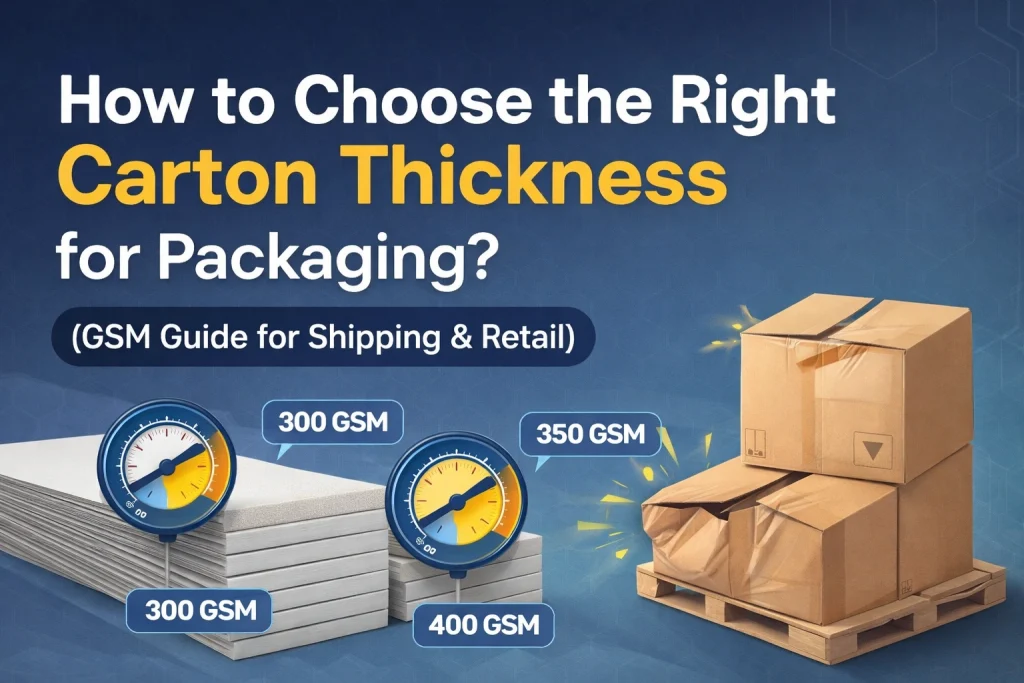
How to Choose the Right Carton Thickness for Packaging? (GSM Guide for Shipping & Retail)
Choosing the right carton thickness isn’t about guessing what feels sturdy enough or copying what competitors use. It’s about matching material specifications to your specific product weight, shipping method, and whether your packaging needs to perform on retail shelves or survive long-distance courier networks. Get it wrong, and you’ll either overspend on unnecessarily thick material or face constant returns from crushed cartons.
Most founders discover carton thickness problems only after production, when customer complaints start arriving about dented boxes or when they realize they’re paying 40% more than necessary for over-engineered packaging. This guide explains exactly what carton thickness means, how to choose appropriate GSM for different scenarios, and how carton structure works with thickness to create packaging that protects reliably without wasting money.
Understanding Carton Thickness and Why It Matters
Carton thickness is measured in GSM—grams per square meter—which indicates the weight and density of the paperboard material. A 300 GSM board means one square meter of that material weighs 300 grams. Higher GSM generally means thicker, more rigid material with better crush resistance.
The thickness you need depends on three factors: product weight, how the packaging will be handled during distribution, and whether the carton needs to maintain appearance for retail display or just protect contents during shipping.
Why Cartons Get Crushed During Shipping
Carton crushing happens when the material lacks sufficient compression strength for the stresses it encounters. During courier shipping across India, packages experience stacking weight—often 20-30kg pressing down on boxes at the bottom of stacks. They face edge impacts when sorted through machinery. They endure compression from strapping and bundling.
A carton that seems sturdy when you hold it empty can collapse under these real-world conditions if the GSM is inadequate for the product’s weight inside. Humidity during the monsoon season compounds this problem, reducing compression strength by 20-40%.
Difference Between Retail Packaging vs Courier Packaging
This distinction fundamentally changes your GSM requirements and is one of the most misunderstood aspects of packaging specification.
Retail packaging sits on shelves in controlled environments, handled carefully by store staff and customers. It needs to look pristine and resist minor handling damage. Structural strength requirements are moderate. A 250-280 GSM board often works well for retail cosmetics, supplements, or food products.
Courier packaging survives a much harsher journey—thrown onto conveyor belts, stacked under weight, subjected to vibration during transport, and potentially exposed to temperature extremes and humidity. The same product that only needs 280 GSM for retail typically requires 320-350 GSM minimum when shipped via courier networks.
Many D2C brands use retail-grade packaging for courier shipments because it looks better and costs less. Then they face 8-12% damage rates and wonder why competitors using heavier boards don’t have the same problems.
How Product Weight Impacts Carton Strength
Product weight is the most direct factor in determining minimum GSM requirements. Heavier products create more internal pressure against carton walls and increase compressive load when stacked.
General framework:
-
- Products under 100g: 250-280 GSM for courier shipping
-
- Products 100-250g: 300-320 GSM
-
- Products 250-500g: 350-400 GSM
-
- Products over 500g: Consider corrugated boxes instead
However, product distribution within the carton also matters. A 200g product in a compact cube creates different stress than the same weight in an elongated box.
GSM Options Explained: 250 vs 300 vs 350 vs 400
250 GSM Board
250 GSM is the lightest commonly used for product packaging. It works well for very lightweight products—under 75g—when shipping via careful delivery methods or when used purely for retail display.
This weight is appropriate for sample sizes, small cosmetic items, lightweight supplement bottles, or tea packaging. However, 250 GSM is inadequate for most courier shipping scenarios. The board lacks crush resistance when packages stack and dents easily from handling impacts.
Use 250 GSM only when shipping locally with careful handling, when the product is displayed primarily in retail, or when the carton is purely decorative and an outer box provides actual protection.
300 GSM Board
300 GSM is the sweet spot for lightweight to medium-weight products shipped via courier networks. This thickness balances cost, protection, and shipping weight for products in the 75-200g range.
For skincare bottles, small perfume containers, vitamin bottles, and spice jars, 300 GSM delivers adequate protection through standard courier handling. The board has sufficient compression strength to resist normal stacking and enough rigidity to resist edge impacts.
This GSM works particularly well when combined with appropriate carton structures. A well-designed carton structure in 300 GSM often protects better than a poorly designed structure in 350 GSM.
350 GSM Board
350 GSM provides noticeably better protection than 300 GSM and is worth the 15-20% cost premium when shipping valuable products, dealing with products in the 200-350g range, or when you’ve experienced damage issues with lighter board.
This weight is common for premium skincare products, perfume bottles in the 50-100ml range, supplement bottles with 60-90 capsules, or products where damaged packaging creates disproportionate brand perception problems.
The additional thickness provides better crush resistance, more resilience against edge impacts, and maintains structural integrity better during extended shipping. For products shipping to tier-two and tier-three cities where handling is rougher, 350 GSM often prevents damage that 300 GSM would allow.
400+ GSM Board
Board thickness of 400 GSM and above is where you should question whether folding cartons are the right solution. This heavy board increases material costs significantly, adds shipping weight, and becomes harder to score and fold cleanly.
Use this range only for heavy products—350g and above—or when maximum structural integrity is essential. However, at this weight, corrugated boxes often provide better protection at a lower cost.
When to Use Duplex vs SBS Board
Beyond GSM thickness, board composition affects performance and cost.
Duplex Board
A duplex board consists of multiple layers—typically a grey recycled fiber core with white outer layers. This construction provides good strength at a moderate cost. The grey core is visible on cut edges.
Duplex works well for products where cost efficiency matters more than premium appearance. It’s suitable for food packaging, wellness products, beauty, and personal care items at mid-market price points. The recycled fiber core makes duplex more environmentally friendly than virgin fiber boards.
SBS Board
SBS board uses virgin fiber throughout, creating bright white material inside and out. It accepts printing ink more uniformly and delivers the most premium appearance among folding carton materials.
SBS is appropriate for luxury skincare, premium perfumes, high-end supplements, and products where packaging quality directly affects perceived product value. The cost premium over duplex—typically 30-50%—only makes sense when your price point and brand positioning justify the investment.
For most D2C brands shipping products in the ₹500-2,000 range, quality duplex board in appropriate GSM provides better value than SBS.
How Shipping Method Changes GSM Choice
Courier Shipping (Individual Packages)
Standard courier shipping creates the harshest conditions for packaging. Use the higher end of GSM recommendations for your product weight. Budget 300-350 GSM as baseline for most products under 300g.
Retail Distribution (Palletized Shipping)
Products shipping in bulk to retail stores travel on pallets, wrapped and protected as larger units. Individual cartons face less stress. You can often reduce GSM by one tier—using 280 GSM where courier shipping would need 320 GSM.
Hand Delivery or Local Distribution
If you’re delivering products locally within your city via your own logistics, you control handling quality. This allows using lighter GSM since you know products won’t be thrown onto conveyor belts or stacked carelessly.
How Carton Structure Enhances Material Performance
Once you’ve determined the appropriate board thickness for your product weight and shipping method, carton structure becomes equally important in packaging performance. The same GSM material performs very differently depending on how the carton is designed.
Straight Tuck In (STI) and Reverse Tuck End (RTE) Cartons
These standard folding carton structures work well for lightweight to medium-weight products when constructed with appropriate GSM. The tuck flap closures rely on friction to stay closed, making them suitable for products where weight doesn’t create excessive stress on closures.
STI and RTE structures are economical to manufacture, easy to assemble during packing, and provide adequate protection for most retail and courier applications when using proper board thickness. They’re the default choice for skincare bottles, supplement containers, and cosmetic products in the 50-250g range when using 300-350 GSM board.
For detailed guidance on when Straight Tuck In cartons are the right choice for your products, see our comprehensive STI carton guide.
Auto Lock Bottom (ALB) Cartons
Auto-lock bottom structures provide superior bottom closure security compared to tuck-style cartons. The bottom locks mechanically when the carton is opened for packing, creating a more secure base that won’t work open under product weight.
ALB structures are particularly valuable for heavier products—above 200g—or when fast packing speed matters. The structure also distributes weight more effectively across the carton base, allowing lighter GSM to perform adequately compared to tuck-style cartons carrying the same product weight.
Explore our detailed Auto Lock Bottom carton guide to understand when this structure provides better value than standard tuck designs.
Tray and Sleeve Combinations
Tray and sleeve structures separate the carton into two components—a tray that holds the product and a sleeve that slides over the tray. This design provides a premium presentation and easy access while maintaining structural integrity.
The structure works well when the product itself is heavy or oddly shaped. You can use heavier GSM for the tray (350-400 GSM) for structural support while using moderate GSM for the sleeve (280-300 GSM) for cost efficiency.
Combo Cartons for Multiple Products
When packaging multiple products together—gift sets, product bundles, or multi-item kits—combo carton structures with internal dividers distribute weight and protect products from impacting each other during shipping.
These structures typically require heavier GSM than single-product cartons because the total weight is higher. Plan for 350-400 GSM when packaging multiple bottles or jars together, especially if the total weight exceeds 300g.
Master Carton Engineering
For brands shipping in bulk or selling through retail distribution, master cartons provide outer protection for multiple individual product cartons. Master cartons typically use corrugated board because they need to protect a higher total weight and survive rougher handling.
Proper master carton design protects your individual product cartons, allowing you to use lighter GSM for individual cartons than you’d need if shipping them individually. Learn more about master carton engineering for efficient bulk shipping protection.
Making the Final Decision
Choosing carton thickness requires balancing protection needs, cost constraints, and brand presentation requirements. Start with your product weight and shipping method to establish baseline GSM requirements. Then adjust based on your specific situation:
Increase GSM if shipping long distances, dealing with rough courier networks, shipping during monsoon season, or packaging valuable products where damage creates disproportionate brand impact.
Decrease GSM if shipping primarily to retail, using palletized distribution, controlling your own logistics, or when cost efficiency is critical, and some damage risk is acceptable.
Test your packaging under realistic conditions before committing to full production. Fill cartons with actual product, ship them to yourself using your intended courier partners, expose them to temperature and humidity variations. The small cost of testing prevents much higher costs from systematic packaging failures.
Conclusion
Carton thickness isn’t a decision you make once and forget. As your products evolve, as you enter new distribution channels, as shipping conditions change seasonally, your GSM requirements may shift.
The investment in appropriate board thickness pays returns through reduced damage rates, improved customer satisfaction, and avoided returns processing costs. Under-specified packaging that saves ₹3 per unit costs you ₹200-300 when damaged products need refunding. Over-specified packaging that costs ₹8 extra per unit wastes thousands annually across volume shipments.
Get the specification right by understanding your actual requirements, testing under real conditions, and working with experienced partners who prioritize performance over convenience.