
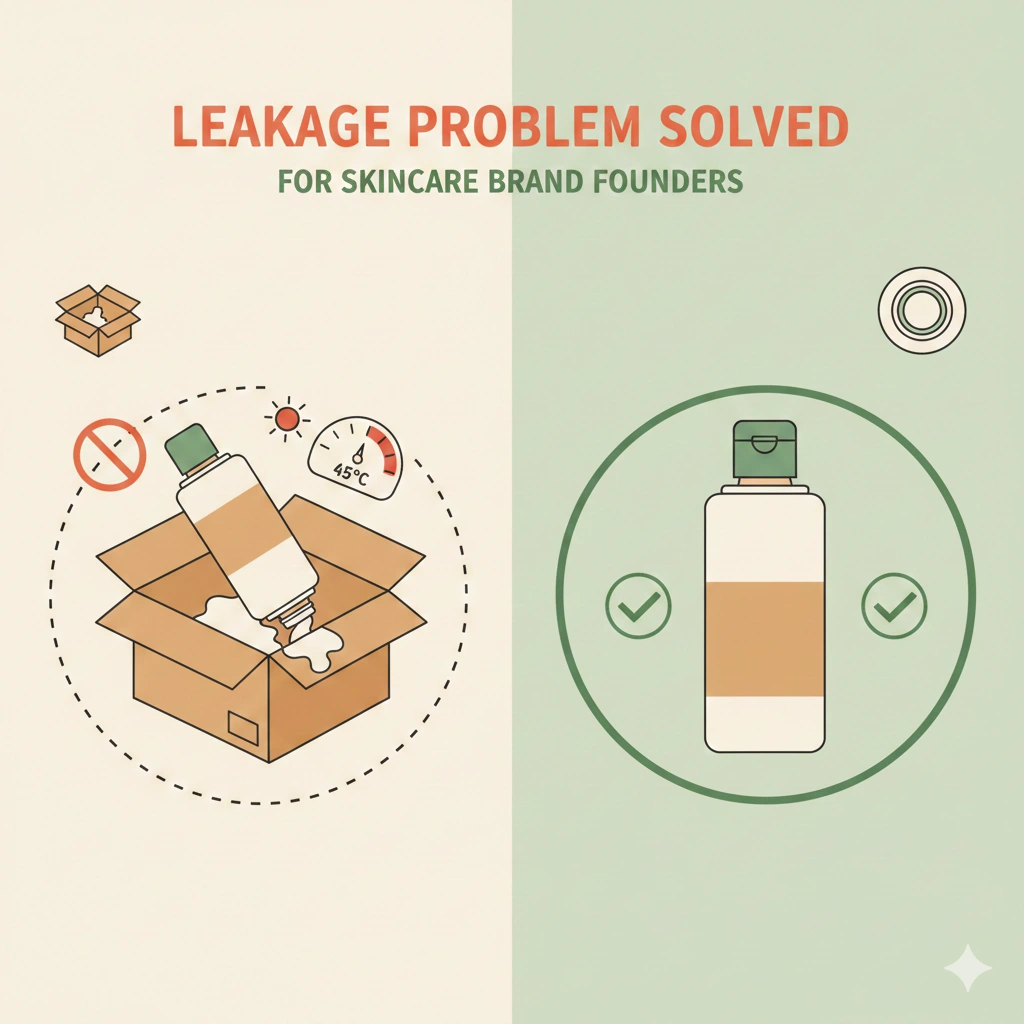
Why Skincare & Oil Brands Face Leakage During Shipping (And How to Fix It)
If you’ve ever opened a returned package to find product leaked all over the box, or received customer complaints about oily residue on their delivery, you know exactly how frustrating leakage problems are. One leaked shipment means lost product, refund costs, damaged customer relationships, and often a negative review that affects future sales.
Leakage is the single most common packaging complaint for skincare and oil-based product brands. It accounts for 30-40% of all packaging-related returns in the personal care industry. The worst part is that most founders discover leakage issues only after scaling production, when dozens or hundreds of units have already shipped.
This isn’t about bad luck or rough courier handling. Leakage happens because of specific, fixable mismatches between your product characteristics, container design, closure selection, and shipping conditions. This guide explains exactly why leakage occurs and how to prevent it before it costs you more customers.
Why Liquid Products Leak During Transit
Products don’t leak when sitting still on a shelf. They leak because shipping creates conditions your packaging wasn’t designed to handle.
When courier companies move packages, bottles are subjected to constant movement, orientation changes, and temperature fluctuations. Your bottle might be upright when it leaves your facility, but it could spend hours lying on its side or upside down during transit. Every position change creates opportunities for the product to reach the closure seal from different angles.
Temperature changes during Indian shipping are particularly challenging. A package might start in your air-conditioned facility at 22°C, spend time in a courier vehicle that reaches 45-50°C during summer, then get stored overnight in a cooler facility. These temperature swings cause product expansion and contraction. Without adequate headspace, expanding product has nowhere to go except past the closure seal.
Pressure changes affect sealed containers when packages are stacked during transport. Weight pressing down can force the product past closures. Air freight creates pressure variations as planes climb and descend. The combination means your packaging needs to perform reliably across a wide range of conditions.
Why Oil-Based Products Are Particularly Prone to Leakage
If you’re selling facial oils, body oils, or oil-based serums, you’re dealing with one of the most challenging product types for leak prevention.
Oils have low viscosity and surface tension, meaning they flow easily and can seep through tiny gaps that would contain water-based products. Where a lotion might stay contained with a slightly loose closure, oil will find every microscopic opening.
Oil penetrates closure threading more readily than water-based products. The space between screw cap threads creates a pathway. Water-based products stay contained, but oils migrate through the threading gaps during shipping, movement, and temperature changes.
Many oils reduce the effectiveness of standard closure gaskets over time. Some natural oils can cause certain plastics and rubber seal materials to swell or soften, compromising seal integrity. This isn’t visible immediately, but after days in transit, the degraded seal allows leakage.
Oil residue on bottle rims during filling creates another vulnerability. Even a thin film of oil prevents closures from sealing properly. Many filling operations don’t include rim cleaning before capping, leaving microscopic oil residue that creates leak paths.
The 5 Most Common Causes of Shipping Leakage
1. Wrong Closure Type for Product Viscosity
The most frequent leakage cause is using closures designed for different viscosity products. Disc top caps work well for thick lotions because the product doesn’t flow easily. Use that same disc top on thin facial oil, and the product flows right through during shipping.
Standard screw caps without inner seal liners provide only the threaded connection. For water-based products, this might be adequate. For oils and thin liquids, it’s almost guaranteed to leak during extended shipping.
The fix: Thin oils and serums need screw caps with foam or rubber seal liners that create compression seals. Medium-viscosity products can use disc tops with a good seal design. Match closure design to your specific product viscosity.
2. Missing or Inadequate Liner Seals
Liner seals provide critical secondary protection against leakage. Many brands skip them to save ₹2-3 per unit, not realizing this small cost prevents returns that cost ₹200-300 per incident.
Even when brands use liner seals, poor application creates problems. Pressure-sensitive liners need absolutely clean, dry bottle rims to adhere. Any product residue prevents proper bonding. The liner appears sealed but gradually peels away during shipping.
The fix: Always use liner seals for liquid and oil products. Ensure your filling process includes cleaning bottle rims with lint-free material before applying caps. Test sealed bottles by storing them inverted for 48-72 hours before shipping to customers.
3. Insufficient Headspace in Containers
Over-filling containers is one of the easiest mistakes to make. When you fill bottles to 95-100% capacity, there’s no room for thermal expansion during shipping.
A temperature increase of just 20-25°C can cause product volume to expand by 2-4%. In a 100ml bottle filled to 98ml, that expansion has nowhere to go except past the closure. The pressure forces the product through any gap in the seal.
The problem compounds when bottles are laid on their sides. In an upright position, an expanded product might compress the air space. On its side, the product is already against the closure seal, and any expansion creates immediate pressure that forces leakage.
The fix: Leave adequate headspace for your product type. For oils and thin liquids, fill to 85-90% capacity maximum. For products shipping in summer, reduce fill levels further. Document target fill weights and implement quality checks during production.
4. Inadequate Closure Tightening
Inconsistent closure tightening during filling is a common leakage cause, especially for brands filling manually or with semi-automated equipment.
Hand-tightening creates variability. One person might apply firm pressure while another barely snugs the cap. Bottles that receive inadequate tightening develop slow leaks during shipping.
Cross-threading happens more often than founders realize. A cross-threaded cap might feel tight, but it doesn’t create a proper seal because the threads aren’t properly engaged. These bottles almost always leak during shipping.
The fix: Train your team on proper tightening technique and verify closure tightness on every unit. Consider handheld torque tools for consistent tightening force. For automated filling, establish proper torque settings and implement regular calibration checks.
5. Container and Closure Incompatibility
Not all bottles and closures are compatible, even if they appear to fit. Thread designs vary between manufacturers. A cap that fits one supplier’s bottle might not seal properly on another supplier’s bottle.
Bottle rim finish quality affects seal integrity significantly. Inexpensive bottles sometimes have rough or uneven rim finishes that prevent closures from sealing uniformly. You might get an adequate seal on 80% of bottles, while 20% leak.
The fix: Source bottles and closures from the same manufacturer as matched systems when possible. If buying separately, test compatibility thoroughly. Fill test bottles, seal them, and subject them to stress conditions, including temperature cycling and extended storage in various positions.
How to Prevent Leakage: Step-by-Step Protocol
Step 1: Choose Appropriate Containers and Closures
Start with containers designed for liquid products with smooth rim finishes. For oils and thin liquids, prioritize bottles with narrow openings that require less seal area.
Select closures specifically rated for your product viscosity. Test with your actual product, not just water. Verify that closures include appropriate seal materials—foam or rubber liners for liquids and oils.
Step 2: Implement Quality Filling Processes
Clean bottle rims after filling and before capping. Use lint-free wipes to remove any product residue. This single step prevents a significant percentage of leakage issues.
Establish consistent fill levels using calibrated equipment or measuring tools. Apply closures with consistent torque and verify tightness as a secondary check.
Step 3: Add Liner Seals
Apply liner seals appropriate to your product type. Test sealed bottles by inverting them for 48 hours. Check for any product seepage at the liner seal edge.
Step 4: Test Under Shipping Conditions
Create realistic shipping simulations. Subject test packages to temperature cycling—leave them in hot environments, then move to cool environments. Store them on their sides and inverted.
Ship test packages to yourself using your actual courier partners. Inspect for any leakage, loose closures, or compromised seals upon arrival.
Step 5: Monitor Return Data
Record every leakage incident with details about which product and batch. Look for patterns. Is leakage higher during certain seasons or in certain shipping zones? Use this data to make targeted improvements.
Frequently Asked Questions About Shipping Leakage
Why do my products only leak during shipping but not in storage?
Storage keeps products upright at stable temperatures. Shipping involves constant movement, position changes, and temperature fluctuations that stress seals. A seal that holds when upright and stable may fail when the bottle is on its side, experiencing thermal expansion.
How much headspace should I leave in bottles to prevent leakage?
For oils and thin liquids, leave 10-15% headspace (fill to 85-90% capacity). For thicker products, 5-10% headspace is usually adequate. During summer or for long-distance shipments, increase headspace to accommodate greater thermal expansion.
Are glass bottles less likely to leak than plastic bottles?
Glass bottles themselves don’t leak, but they don’t prevent closure leakage any better than quality plastic bottles. The leakage issue is almost always at the closure seal, not the container material. Glass maintains consistent rim dimensions better than some low-quality plastic, which can help seal consistency.
Do I need liner seals if I’m using screw caps?
Yes, for liquid and oil products. Screw caps alone rely on thread engagement. Liner seals provide secondary protection that catches leakage if the primary closure seal is compromised. The small cost of liner seals prevents much higher costs from leakage returns.
Can I fix the leakage by just tightening the caps more?
Over-tightening can strip threads or crack bottle rims. The solution is an appropriate closure design with proper seal materials, combined with consistent tightening at correct torque levels. If you’re experiencing leakage despite tight closures, the closure design or seal materials likely aren’t appropriate for your product.
Why do some bottles in the same batch leak while others don’t?
Inconsistency suggests variability in your filling or capping process. Possible causes include inconsistent fill levels, variable closure tightening, incomplete liner seal adhesion due to product residue, or quality variations in bottle rim finish. Implement quality control checks during production to identify inconsistencies.
Should I use different packaging for summer versus winter shipments?
If you’re experiencing seasonal leakage spikes, yes. Reduce fill levels during summer to accommodate greater thermal expansion, or consider upgraded closures with better high-temperature seal performance. Track return rates by season to determine if seasonal adjustments are justified.
Conclusion
Preventing shipping leakage isn’t about finding one perfect solution. It’s about designing a complete system where product viscosity, container design, closure selection, liner seals, fill levels, and shipping conditions all work together.
Most leakage problems come from mismatches in this system. The closure is fine for thick products but wrong for thin oils. The fill level is appropriate for stable storage but inadequate for temperature fluctuations during shipping.
Start by understanding your specific product characteristics and typical shipping conditions. Test packaging under realistic stress conditions before scaling production. Implement quality control at each filling and sealing step. Monitor return data to catch problems early.
The investment in proper packaging components and processes pays for itself quickly through reduced returns, preserved customer relationships, and protected brand reputation. One prevented leakage incident saves enough to pay for liner seals on 50-100 bottles.