
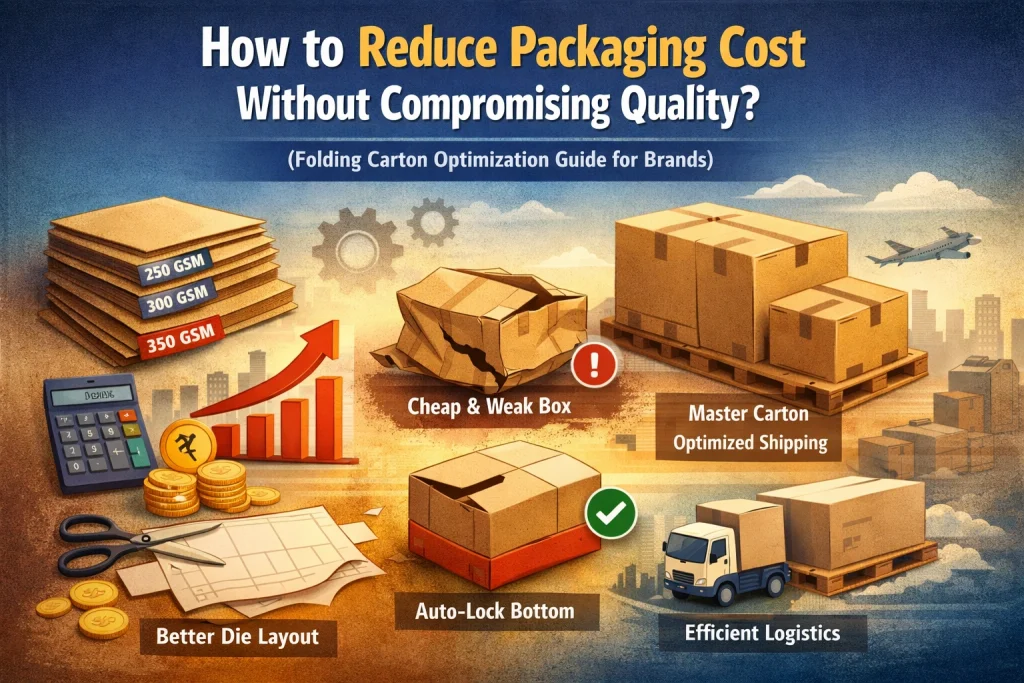
If your packaging costs have jumped 20-30% in the last 18 months, you’re not imagining it. Every founder we speak with mentions the same problem: carton suppliers are raising prices, but margins are already tight, and simply passing costs to customers isn’t an option in competitive D2C markets.
The natural response is to look for cheaper packaging. But here’s what actually happens—brands reduce GSM from 350 to 280, damage rates spike from 3% to 12%, customer complaints multiply, and the money “saved” on cheaper cartons gets eaten by refunds and replacements. You end up spending more while delivering a worse customer experience.
This guide explains how to actually reduce packaging costs without the damage rate increase. Not through blanket cost-cutting, but through intelligent optimization of material specifications, carton dimensions, structural design, and logistics efficiency.
Why Packaging Costs Are Suddenly Increasing
Understanding why costs are rising helps you know which costs are negotiable and which aren’t, so you can focus optimization efforts where they’ll actually work.
Raw Material Price Volatility
The packaging industry is facing a perfect storm of cost pressures. The Russia-Ukraine conflict disrupted global pulp supply chains starting in 2022, and those effects continue to affect markets. Russia and Ukraine together supplied approximately 10-12% of global wood pulp exports. When that supply contracted, pulp prices spiked globally, and Indian paperboard manufacturers saw input costs jump 20-30%.
Now, the USA-Iran conflict and closure of the Strait of Hormuz have created another massive shock. Oil prices trading above $100 per barrel directly impact packaging costs through multiple channels. Crude oil is a key input for chemicals used in paperboard coatings, adhesives, and treatments. The polymer-based barrier coatings that many brands use for moisture protection are petroleum derivatives—their costs track crude prices closely.
More significantly, energy costs for paperboard manufacturing have spiked. The paperboard production process is energy-intensive, requiring substantial electricity for pulping, drying, and finishing. With oil above $100, power generation costs increase, and these get passed through to carton prices. Many paperboard mills are seeing energy costs that are 35-45% higher than two years ago.
Shipping costs for raw materials have also increased substantially. Pulp imported from Indonesia, Thailand, or North America now costs more to transport due to higher bunker fuel prices and longer routing to avoid conflict zones. These logistics premiums get built into paperboard prices.
This isn’t temporary volatility that will normalize in 3-6 months. The geopolitical situation remains unstable, oil markets are recalibrating to new supply constraints, and even if conflicts are resolved, prices are unlikely to return to pre-crisis levels quickly. Brands need strategies that work at current price levels, not plans that assume prices will drop.
Impact on D2C Brand Margins
For D2C brands operating on 20-35% gross margins, a 25% increase in packaging costs has a disproportionate impact. If packaging represented 8% of your product cost, that 25% increase means packaging is now eating 10% of product cost. On a ₹500 product with 30% gross margin, that additional 2% in packaging cost reduces your gross margin to 28%—a 6.7% reduction in margin percentage.
Multiply this across thousands of units monthly, and the impact becomes substantial. A brand shipping 5,000 units monthly at ₹500 average order value sees a monthly gross profit decrease by approximately ₹50,000 from packaging cost increases alone. That’s ₹6 lakhs annually that needs to come from somewhere.
The problem compounds because other costs are also rising—shipping rates up due to fuel costs, payment gateway fees increasing with inflation, and customer acquisition costs climbing. Packaging isn’t the only margin pressure, making optimization even more critical.
Why Reducing GSM Blindly Leads to Product Damage
When costs spike, the immediate instinct is to reduce material thickness. If a 350 GSM board costs ₹X per carton and a 300 GSM board costs 15% less, switching seems obvious. But material thickness isn’t arbitrary—it’s matched to product weight, shipping method, and handling conditions.
In many cases, brands are over-specifying 350 GSM when 300 GSM with the correct structure would perform better. But equally often, brands using 300 GSM are already at a minimum adequate thickness for their product weight and shipping conditions. Reducing to 280 GSM saves ₹3-4 per carton but causes 8-10% damage rates instead of 2-3%, costing ₹200-300 per damaged unit.
The math is straightforward: saving ₹4 per carton on 1,000 monthly shipments saves ₹4,000. But increasing damage rates from 3% to 10% means 70 additional damaged units monthly, costing approximately ₹14,000-21,000. You’ve lost ₹10,000-17,000 monthly trying to save ₹4,000.
Practical Strategies to Reduce Packaging Costs
Optimize GSM Without Compromising Strength
The key insight: strength isn’t only about material thickness. It’s about how material thickness combines with structural design to resist actual stresses your packaging encounters.
Start by understanding what loads your packaging actually experiences. Calculate product weight, typical stacking heights in distribution, and compression forces during transport. For most D2C products under 200g, shipping via courier, 300-320 GSM provides adequate protection when combined with appropriate structure.
Many brands use 350 GSM because it feels substantial or because that’s what competitors use. But if your product weighs 150g and ships in well-designed cartons, 320 GSM often performs identically to 350 GSM while costing 10-12% less. Test this properly—fill sample cartons with actual product, ship them through your actual courier partners, and track damage rates.
The opposite applies when brands are under-specifying. If you’re using 280 GSM and seeing 6-8% damage rates, upgrading to 320 GSM costs approximately ₹4-5 more per carton but reduces damage to 2-3%, saving ₹200-250 per prevented damage incident. The upgrade pays for itself immediately.
Right-Size Cartons to Reduce Material Wastage
Oversized cartons waste material directly and increase shipping costs through dimensional weight charges. Every extra centimeter in length, width, or height uses more paperboard and potentially bumps you into higher dimensional weight brackets.
Review your carton dimensions against actual product dimensions. Ideally, maintain 5-10mm clearance around products for protection and easy insertion, but anything beyond that is waste. A carton that’s 140mm when 130mm would work uses 7-8% more material for no functional benefit.
This becomes particularly important for brands with multiple product sizes. Instead of unique carton dimensions for every product, identify 2-3 standard sizes that accommodate your product range with minimal waste. Standardization allows better sheet utilization during manufacturing and gives you volume leverage with suppliers.
Optimize Die-Line Layout for Better Sheet Utilization
Sheet utilization—how many cartons can be cut from a standard paperboard sheet—directly impacts cost. Better utilization means lower cost per carton from the same material.
Standard paperboard sheets come in specific sizes. If your carton dimensions are slightly off, you might get 16 cartons per sheet when different dimensions could yield 18 cartons per sheet—a 12.5% material cost reduction for the same protection.
Work with your folding carton manufacturer to optimize die-line layouts. Sometimes adjusting carton dimensions by 5-10mm in one direction—insignificant for product fit—allows dramatically better sheet utilization. Manufacturers with technical expertise can often identify these opportunities if you give them the flexibility to suggest dimension adjustments.
When to Reduce Board Thickness vs When Not to
Reduce board thickness when you’re using a heavier board for aesthetic reasons rather than structural needs, shipping primarily through controlled distribution, can offset thickness reduction with structural improvements, or testing confirms the lighter board performs adequately.
Don’t reduce board thickness when you’re already seeing damage rates above 3-4%, products weigh more than 200g, shipping long distances through multiple courier handling points, shipping during monsoon season when humidity reduces board strength, or products are high-value where damage cost far exceeds packaging cost savings.
Calculate your current damage rate costs, estimate the impact of board thickness changes on damage rates, and compare total costs under different scenarios.
Reduce Over-Packaging and Optimize Master Cartons
Many brands use unnecessary packaging layers that add cost without proportional protection—outer cartons when products already have adequate individual cartons, excessive void fill when properly sized cartons wouldn’t need it, and unnecessary inserts that don’t improve functionality.
Audit your current packaging component by component. For each element, ask: Does this actually improve product protection? Does this affect customer perception enough to justify the cost? What happens if we eliminate this?
Master cartons for bulk shipping offer significant cost optimization opportunities. Optimize master carton dimensions to maximize pallet utilization. Standard pallets are 1000mm x 1200mm. Master cartons designed to fit efficiently allow more units per pallet, reducing per-unit freight costs. A master carton that’s slightly oversized might mean you fit 36 units per pallet instead of 40, increasing per-unit shipping cost by 11%.
How Carton Structure Selection Impacts Total Cost
While material selection plays a major role in cost, carton structure selection is often the biggest hidden lever for optimization. Different structures have different cost profiles, assembly requirements, and performance characteristics that affect total cost beyond just material price.
STI and RTE: Cost-Efficient for Lightweight Retail
Straight Tuck In (STI) and Reverse Tuck End (RTE) structures are the most economical folding carton designs. They’re simple to manufacture, use minimal material, and assemble quickly.
For lightweight products under 150g, particularly those sold primarily through retail, where handling is controlled, STI and RTE structures in 300 GSM offer excellent cost-to-performance ratios. The simplicity keeps manufacturing costs low, and the structure provides adequate protection when the product’s weight doesn’t stress the closures. Compare cost-efficient carton structures for your lightweight retail products.
Auto Lock Bottom: Better Total Economics
Auto Lock Bottom (ALB) cartons cost approximately 8-12% more than equivalent STI cartons due to more complex manufacturing. But they often reduce total cost through faster assembly during packing operations and better protection, reducing damage rates.
The auto-locking mechanism eliminates one manual tucking step during assembly. For brands packing significant volume, this time saving can reduce labor costs enough to offset higher carton costs. A packing operation filling 500 units daily saves approximately 2-3 hours of labor weekly with ALB vs STI.
More importantly, ALB structures distribute weight across the entire bottom surface instead of relying on tuck flap friction. For products 150-300g, this often allows using 300 GSM with ALB structure instead of 350 GSM with STI structure while achieving better protection. The board thickness cost saving offsets the structure complexity cost.
Calculate total cost, including labor and damage rates, not just material cost. ALB often wins on total cost for mid-weight products even though the unit carton cost is higher. Explore stronger carton options that reduce total packaging costs through better performance.
Tray and Sleeve: When Presentation Justifies Cost
Tray and sleeve structures cost 25-40% more than standard folding cartons. This is only justified when product positioning requires premium presentation and customers actually perceive the presentation value.
For luxury skincare, premium perfumes, or gift-positioned products where packaging significantly influences purchase decisions, the additional cost may be justified. However, many brands use tray and sleeve designs when their products don’t command premium pricing and customers don’t particularly value elaborate packaging.
Combo Cartons and Master Carton Engineering
When selling product bundles or multi-item kits, combo cartons with internal structures can actually reduce total packaging cost compared to packaging each item separately. A single combo carton with dividers costs more than one standard carton but less than multiple separate cartons plus outer packaging. Learn about multi-product packaging solutions that reduce component costs.
Properly engineered master cartons for bulk shipping affect logistics costs significantly. Master cartons designed for optimal pallet utilization can reduce per-unit freight costs by 10-15%. If you’re shipping 10,000 units monthly with an average freight cost of ₹30 per unit, a better master carton design can save ₹30,000-45,000 monthly. Optimize shipping performance with master carton engineering designed for Indian logistics networks.
Frequently Asked Questions
How much can I realistically save by optimizing packaging?
Most brands can reduce packaging costs by 12-20% through combined optimization of GSM, carton sizing, structure selection, and logistics efficiency, while maintaining or reducing current damage rates. The savings come from eliminating over-specification, improving material utilization, and reducing logistics costs.
Should I reduce GSM or change the carton structure to save money?
It depends on your current specifications. If you’re using 350 GSM where 320 GSM would perform adequately, reduce GSM. If you’re using tuck-style structures for products over 200g, changing to an ALB structure often allows lighter GSM while improving protection. Often, the best approach combines both.
How do I know if my current packaging is over-specified?
Calculate your actual damage rate over the last 3-6 months. If it’s under 2%, you likely have room to optimize. Test lighter specifications under realistic conditions—ship samples through your actual couriers, track damage carefully.
Will reducing packaging costs damage my brand perception?
Not if you optimize intelligently. Customers care about receiving undamaged products in reasonable packaging. They don’t know or care whether your board is 320 GSM or 350 GSM. Reduce unnecessary material and optimize structures while maintaining protection and a reasonable appearance.
What’s the biggest cost-saving opportunity most brands miss?
Master carton optimization and right-sizing. Many brands focus only on individual product carton costs while ignoring logistics costs affected by master carton design. A 10% reduction in freight costs through better master cartons often saves more money than a 15% reduction in individual carton material costs.
Should I negotiate with my current supplier or find cheaper suppliers?
Start by optimizing your specifications with your current supplier. Better die-line layouts, right-sized dimensions, and appropriate structures often save 15-20% while working with the same vendor. Switching suppliers for slightly cheaper unit prices without optimizing specs usually saves 5-8% but creates transition headaches.
Conclusion
Reducing packaging costs without compromising quality isn’t about finding the cheapest cartons. It’s about systematic optimization across material specifications, structural design, dimensions, logistics integration, and eliminating genuinely unnecessary components.
Start by understanding your actual requirements—product weight, shipping conditions, and damage rate tolerance. Calculate total cost, including damage rates and logistics costs, not just material costs. Test changes systematically under realistic conditions.
Most brands find 12-20% total cost savings through combined optimization while maintaining or improving protection. These savings don’t come from one big change but from multiple smaller optimizations: right-sized dimensions saving 5%, optimized GSM saving 8%, better structure reducing damage rates by 2%, improved master cartons reducing logistics costs by 12%.
The current high-cost environment, driven by geopolitical instability and oil above $100 per barrel, won’t reverse quickly. Brands that systematically optimize packaging now gain sustainable margin advantages over competitors still absorbing cost increases without optimization.