Launching a New Product? Start With the Packaging Requirement.
Getting a new product manufactured is only part of the launch.
You also need to decide how the product will be packed, what structure it needs, which material is appropriate, how the product will fit, how the artwork will be prepared, and whether the packaging can actually be produced at your required quantity.
This is where packaging development becomes important.
At Anaika Enterprises, we help brands and businesses work through these decisions before production — from understanding the product and developing the structure to sampling, product fitment, artwork coordination, proofing and production.
We work across folding cartons, corrugated boxes, rigid boxes, HDPE bottles, labels and custom packaging components.
You bring the product and requirements. We help work out the packaging.
Why Packaging Development Matters
A packaging requirement can look simple at first:
“I need a printed box for this product.”
But several decisions sit behind that requirement.
- What box structure should be used?
- What board or material is suitable?
- How much clearance should the product have?
- Will the product move inside the box?
- Does the carton need an insert or liner?
- Can the structure handle the product weight?
- How will the artwork fit on the dieline?
- Will fine print reproduce properly?
- Is a physical sample required?
- Can the packaging be produced at the required quantity?
- How will the finished packaging be transported and stored?
These questions become particularly important when developing new products, new SKUs, custom structures or low-to-medium quantity packaging.
A structured development process allows these decisions to be evaluated before committing to the final production quantity.

What Anaika Does in Packaging Development
We don’t expect the buyer to arrive with every packaging specification already decided.
A development requirement can begin with something as simple as:
Product + Quantity + Requirement + Reference
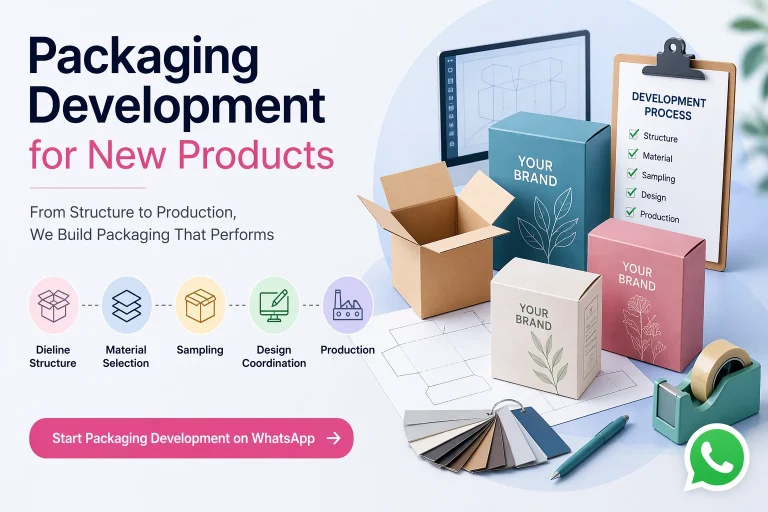
From there, the development may involve:
Product measurement
↓
Structure selection
↓
Material selection
↓
Dieline development
↓
Physical sample
↓
Product fitment
↓
Artwork coordination
↓
Print / finishing proof
↓
Approval
↓
Production
The exact steps depend on the product and packaging requirement.
Step 1 — Understand the Product
The first step is understanding what actually needs to go inside the packaging.
We typically look at:
- Product dimensions
- Product weight
- Product shape
- Number of units
- Filled dimensions
- Packing arrangement
- Required quantity
- Retail or e-commerce use
- Transportation requirements
- Desired presentation
- Printing and finishing requirements
Where possible, an actual product or filled pack is preferable to estimated dimensions.
This is especially useful for sachets, pouches, food containers and other products whose dimensions can change after filling.
Step 2 — Select the Packaging Structure
The structure determines how the packaging will actually hold, open, close, and present the product.
Depending on the requirement, this could be:
- Standard tuck-in carton
- Auto-Lock Bottom carton
- Die-cut window carton
- Tray & Sleeve
- Top & Bottom rigid box
- Mailer box
- Ring & Flap corrugated box
- Carton with inner liner
- Bottle holder
- Custom insert
- Multi-compartment carton
The structure is considered against the product, weight, dimensions, packing configuration, presentation, manufacturing process and transportation requirement.
A structure that looks good in a reference photograph may not necessarily be the right structure for another product.
Step 3 — Select the Material
Once the structure is understood, the material specification can be evaluated.
For folding cartons, this may involve 300–400 GSM paperboard, depending on the carton dimensions, product weight, and construction.
For corrugated packaging, the board specification depends on factors such as:
- Product weight
- Box dimensions
- Stacking
- Handling
- Transportation
- Required protection
For rigid packaging, the construction generally involves rigid board with appropriate wrapping and finishing materials.
For HDPE packaging, development involves different considerations including:
- Bottle capacity
- Shape
- Neck finish
- Cap compatibility
- Label area
The objective is not to simply select the thickest or strongest available material.
It is to identify a specification that is appropriate for the actual application.
Step 4 — Develop the Dieline
Once the structure is established, the packaging needs a working dieline.
The dieline defines the physical construction of the packaging, including:
- Cutting lines
- Creasing lines
- Folding panels
- Flaps
- Gluing areas
- Windows
- Printing areas
- Finishing areas
The dieline can then be provided to the design team so the artwork can be positioned around the actual structure.
This is where structural packaging and graphic design need to work together.
Step 5 — Create a Physical Sample
The prototype can be checked for:
Structure
Does it fold and close correctly?
Dimensions
Is the packaging unnecessarily large or too tight?
Fitment
Does the actual product fit correctly?
Packing
Can the product be inserted easily?
Presentation
Does the assembled package look as intended?
Support
Does the structure provide the required support?
For new or custom packaging, this stage can be useful before moving into production.
Step 6 — Test the Actual Product Fitment
The prototype should ideally be checked using the actual product.
This is particularly important for:
- Sachets
- Bottles
- Jars
- Pouches
- Food containers
- Multi-unit packs
- Products with irregular shapes
The fitment process can identify whether the product needs:
- More clearance
- Less clearance
- An insert
- An internal liner
- A different orientation
- A modified carton dimension
- A different structure
The objective is to make the packaging work with the product rather than simply making the product fit an arbitrary box size.
Step 7 — Coordinate Artwork and Printing
The packaging also needs to work from a printing perspective.
This can become important when the carton contains:
- Fine regulatory text
- Nutritional information
- Manufacturing details
- Barcodes
- Small type
- Reverse printing
- Foiling
- Embossing
- Spot UV
A real example from our coffee packaging development
A customer required a compact carton for six coffee powder sachets.
The carton was predominantly black with white reverse text.
During digital proofing, the fine reverse text did not reproduce as cleanly as required.
The artwork was subsequently adjusted, including adding 30% cyan to the black, and an offset proof was requested to evaluate the printing more closely.
The customer was also invited to the production facility to review the printing process.
This is a practical example of why physical proofing and print evaluation can be important parts of packaging development.
Step 8 — Final Approval
Before production, the developed packaging can be reviewed against the actual requirement.
Depending on the project, approval can cover:
- Structure
- Dimensions
- Material
- Product fitment
- Artwork
- Printing
- Finishing
- Closure
- Overall appearance
Once the required approvals are completed, the packaging can move into production.
Step 9 — Production Coordination
After approval, Anaika coordinates the production requirement with the relevant manufacturing partner.
Depending on the packaging, this can involve:
- Printing
- Die-cutting
- Creasing
- Pasting
- Lamination
- Foiling
- Embossing
- Corrugated conversion
- Rigid box production
- Bottle manufacturing
- Label production
The final production specification is based on the approved packaging development and commercial requirement.
Step 10 — Dispatch and Supply
Packaging also has to reach the location where it will be packed or distributed.
Anaika is based in Mumbai and can coordinate packaging requirements for customers in Mumbai/MMR and other markets such as Pune, Nashik, Surat and locations across India, depending on the packaging requirement and logistics route.
For certain structures, logistics can also influence the packaging design.
For example, folding cartons and Ring & Flap corrugated boxes can be supplied flat-packed, reducing the volume occupied before assembly.

Real Packaging Development Examples
Coffee Sachet Carton
Requirement: Pack of 6 coffee powder sachets.
The development involved:
Filled sachet measurement → cigarette-style carton → inner liner → digital proofing → reverse-print evaluation → artwork adjustment → offset proofing.
The challenge wasn’t simply producing a small printed carton.
It involved making the sachet fit, internal liner, carton closure and fine reverse printing work together.
Large Food Tray Carton
Requirement: Packaging for three food containers in approximately a 15 × 6 × 6 inch finished carton.
The customer did not want a corrugated construction for the application.
A 350 GSM JK Ultima paperboard construction was therefore developed and physically proofed.
Where required, the structure can incorporate an Auto-Lock Bottom, with bottom taping used for additional reinforcement depending on the actual packing load.
The physical sample allows the carton to be evaluated with the actual food containers before production.
Large Printed Corrugated Box
A customer required a large printed corrugated carton where a conventional single-piece structure was not the most practical route.
The requirement was developed around a Ring & Flap two-piece structure.
Separating the ring/body and flap makes the large carton more manageable and allows the printing requirement to be handled across two components.
The structure can also be supplied flat-packed, which is useful for storage and transportation.
For the particular application, a construction involving 5-ply corrugated board, 120 GSM inner golden paper and printed 120 GSM duplex pasted on the outside was considered, subject to the final product and production specification.
Packaging Development for Startups, D2C and Growing Brands
You don’t have to be a large FMCG company to need packaging development.
It can be particularly useful when you are:
- Launching a new product
- Introducing a new SKU
- Testing a new packaging format
- Moving from plain to printed packaging
- Developing premium packaging
- Starting with a low or medium quantity
- Changing your existing packaging
- Unsure which structure to select
- Working with multiple packaging components
For a startup, the requirement may not be:
“We need 50,000 boxes.”
It may be:
“We need the right packaging for our first 500 or 1,000 units.”
That changes the commercial decision.
The structure, printing process, material and MOQ all need to be considered together.
Why Use a Packaging Development Partner Instead of Doing Everything Yourself?
It is possible to coordinate packaging independently.
You can:
Find a supplier → request a dieline → prepare artwork → order a sample → check the product → make changes → order another sample → approve → start production.
For a straightforward carton, that may be enough.
But when the packaging involves custom structures, product fitment, inserts, fine printing, multiple components or low quantities, every additional iteration takes time and coordination.
A development partner helps bring these decisions into a more structured process.
The goal isn’t to promise that every project will require only one sample.
Some packaging genuinely needs testing.
The goal is to make each development step purposeful and based on the actual product requirement.
Packaging Development Beyond the Box
Sometimes the packaging requirement is not just a carton.
A product may require:
HDPE Bottle → Cap → Label → Folding Carton
Or:
Product → Custom Insert → Rigid Box
Or:
Sachets → Inner Liner → Folding Carton
Or:
Large Product → Ring & Flap Corrugated Box
Looking at these components together can make the development process easier than sourcing each component without considering how they ultimately work together.
What Should You Send Us?
You don’t need to have the entire packaging specification ready.
You can start by sharing:
- Product photographs
- Product dimensions
- Product weight
- Filled product or sachet dimensions
- Required quantity
- Existing packaging
- Reference photographs
- Desired packaging style
- Artwork, if available
If you have an actual product sample, that can be even more useful for development and fitment.

Who Is Packaging Development For?
This page is particularly relevant to:
D2C brands launching new products
Startups developing their first packaging
FMCG and wellness brands introducing new SKUs
Pharma and healthcare businesses requiring structured packaging
Food and beverage companies
Brands moving to premium packaging
Companies changing an existing packaging format
Businesses looking for low or medium quantity packaging
Design teams that need a packaging supplier to work from their artwork
Related Packaging Applications
Frequently Asked Questions
Q1: What is packaging development?
Q2: Can Anaika help if I don’t know which box structure I need?
Q3: Can you develop packaging around my actual product?
Q4: Do you provide physical samples?
Q5: Can packaging development be done for low quantities?
Q6: Can Anaika help with the packaging dieline?
Q7: Can you help evaluate printing and finishing?
Q8: Can Anaika develop inserts and internal liners?
Q9: Can Anaika handle multiple packaging components?
Q10: How do I start a packaging development project?
Let’s build your packaging the right way
Share your product details — we’ll guide you step-by-step.