
Coffee Sachet Packaging
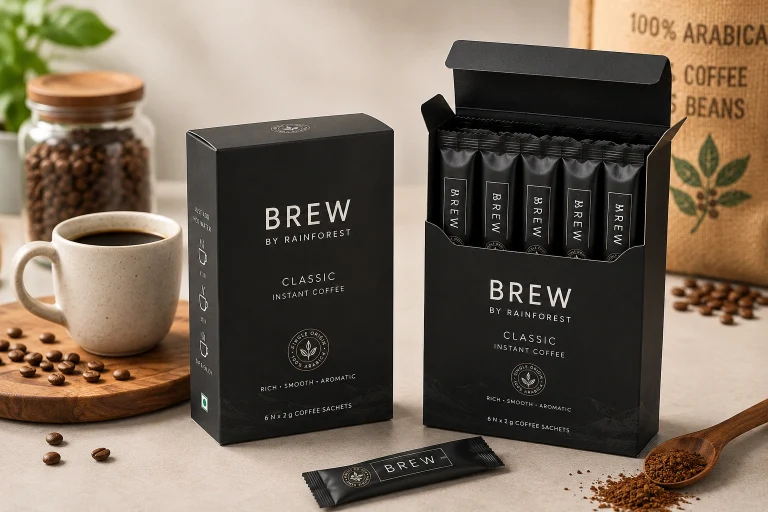
Folding Carton Development for Coffee Sachets & Multi-Sachet Packs
Coffee sachet packaging requires a careful balance between compact structure, product fit, print quality, and brand presentation. When multiple sachets are packed into a small carton, even small dimensional or printing issues can become highly visible.
At Anaika Enterprises, we develop the carton around the actual sachet dimensions and filled weight, followed by physical proofing and print-quality validation.
A recent coffee packaging development involved a pack of 6 coffee powder sachets, where the packaging was developed through multiple stages—from structure selection and digital proofing to artwork refinement and an offset production proof.
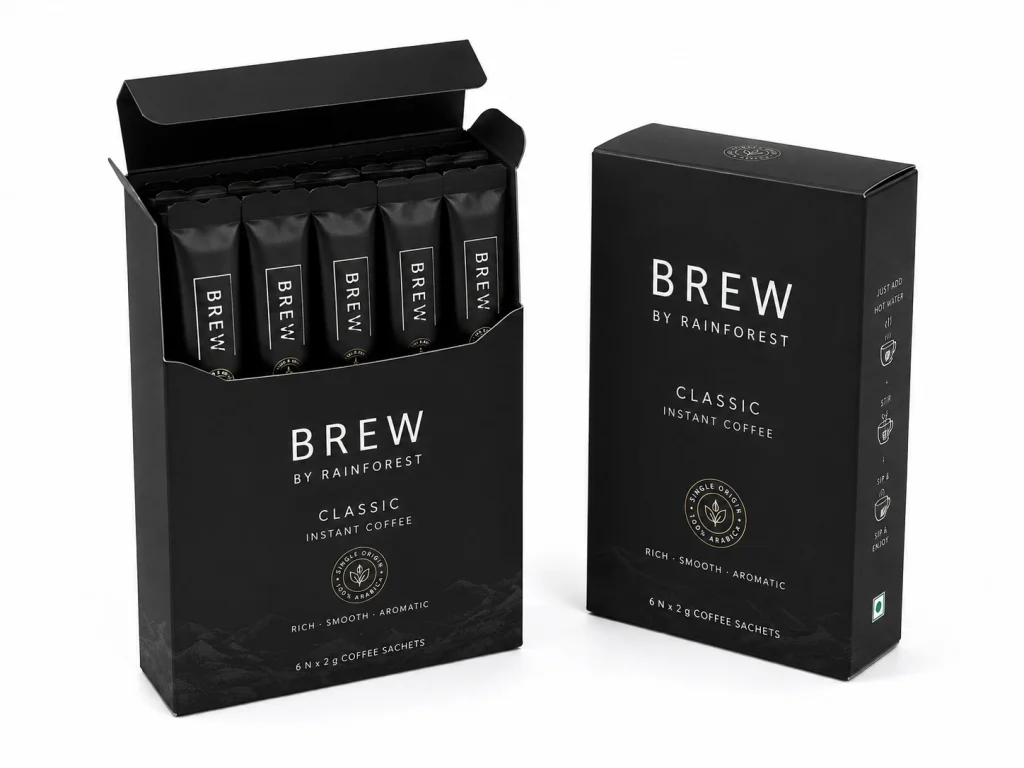
The Packaging Requirement
The initial requirement was straightforward:
6 Coffee Powder Sachets
↓
Compact Retail Carton
↓
Premium Printed Packaging
But because the carton was relatively small, the packaging needed to accommodate both the physical sachets and a significant amount of regulatory and product information.
The development therefore focused on:
- Accurate sachet fit
- Compact carton dimensions
- Secure closure
- Internal liner
- Fine-print readability
- Reverse printing quality
- Premium black packaging
- Production-ready artwork
Want to get your existing product packaging reviewed?
Step 1 — Finalizing the Pack Configuration
Before developing the carton, we first understood the actual product.
The requirement was finalized as a 6-sachet coffee pack.
The filled sachets were then evaluated for their:
- Length
- Width
- Thickness
- Filled weight
- Overall pack arrangement
This information formed the basis for determining the internal carton dimensions.
The box was developed around the product—not the other way around.
Step 2 — Selecting the Carton Structure
For this application, we developed a Cigarette Style Folding Carton.
The structure provides a compact retail format suitable for small sachet-based products while allowing the branding and product information to remain visible on the carton.
An inner liner was incorporated to improve the internal closure and provide a more controlled packing configuration.
The final structure was therefore developed around:
6 Sachets
↓
Inner Liner
↓
Cigarette Style Carton
↓
Retail Pack
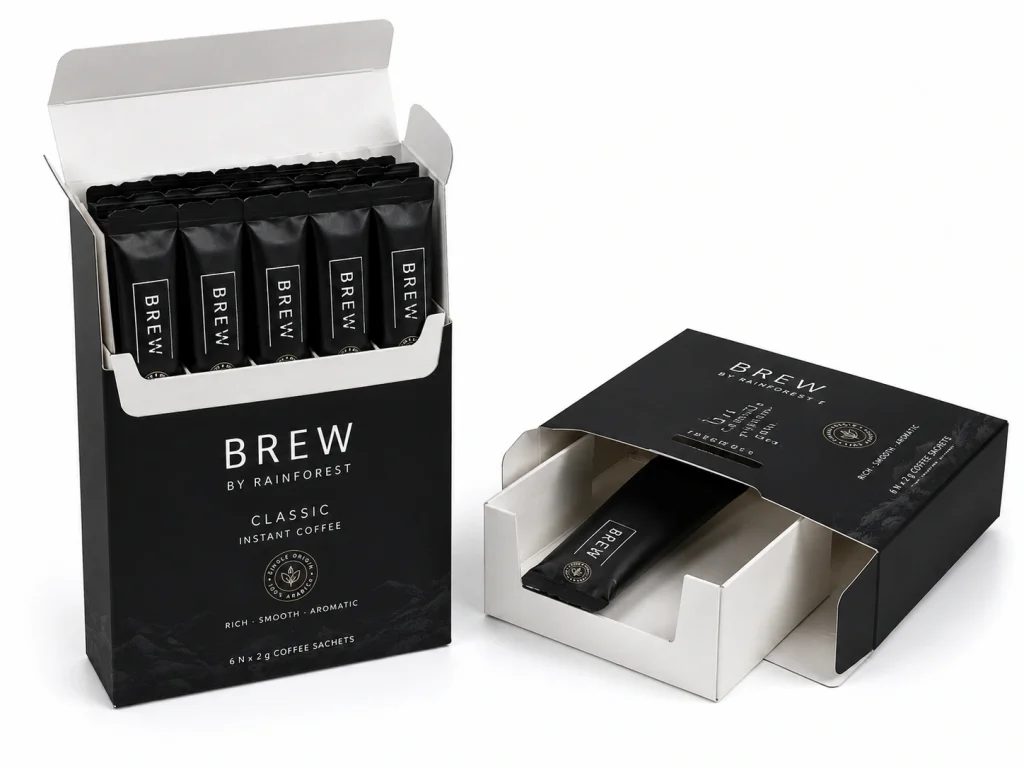
Step 3 — Measuring the Actual Sachets
One of the most important stages was measuring the actual filled sachets.
Sachet dimensions can vary depending on:
- Product fill
- Sealing
- Film thickness
- Powder density
- Filling process
Instead of relying only on nominal dimensions, the filled sachets were used to determine the practical carton size.
This helps reduce problems such as:
- Loose sachets
- Excessive internal movement
- Difficult packing
- Over-tight carton fit
- Closure problems
Step 4 — Digital Proofing
Once the structure and dimensions were finalized, samples were produced using a digital proofing machine.
This allowed the client to evaluate:
- Physical dimensions
- Sachet fit
- Carton structure
- Artwork
- Folding
- Closure
- Overall presentation
Digital proofing provided an efficient way to validate the packaging before moving towards production.
The Printing Challenge
The biggest challenge appeared during the digital proof.
The carton artwork used a black background with white typography.
This is commonly referred to as reverse printing—the white areas are created by leaving the paper unprinted rather than printing white ink.
The carton also contained:
- Nutritional information
- Manufacturing details
- Regulatory information
- Fine-print text
Because the carton was small, this fine text had to remain extremely sharp.
During digital proofing, some of the fine reverse text appeared smudged or insufficiently crisp.
This created a practical production question:
Would offset printing provide better definition for the fine reverse text?
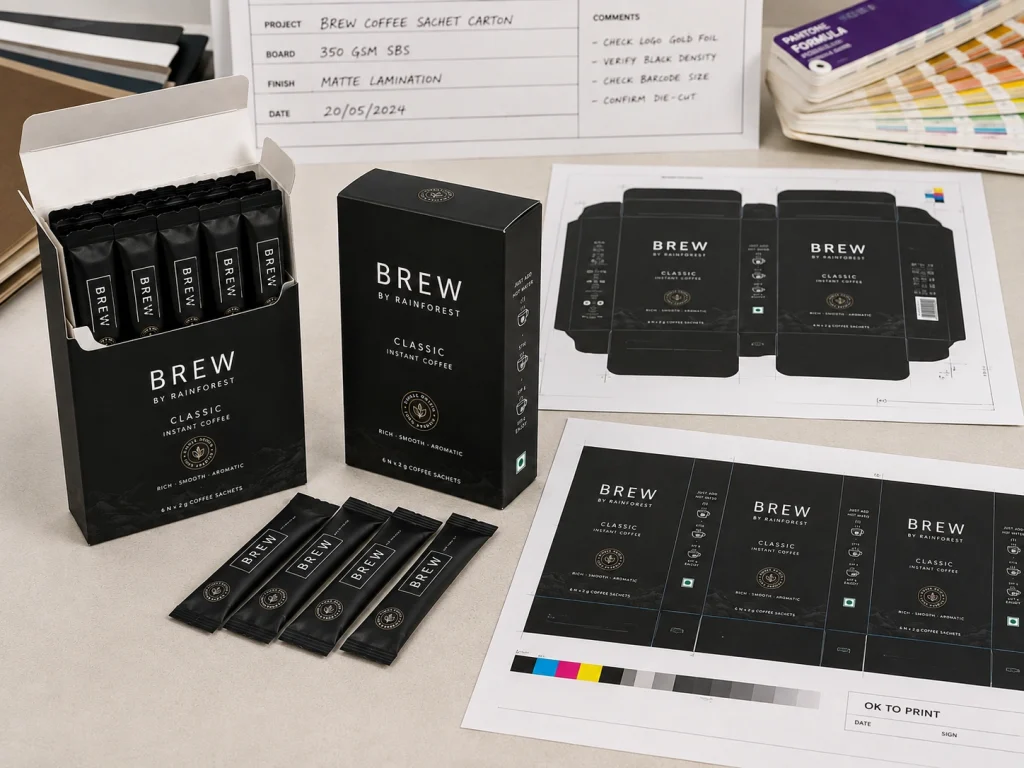
Artwork Refinement
Before proceeding to the next proofing stage, the artwork was also refined.
For the black artwork area, 30% Cyan was added to the black build as part of the print optimization for this specific application.
The objective was to achieve a more controlled and crisp appearance in the dark printed areas and improve the overall definition of the reverse text.
The exact colour build should always be validated against the selected printing process, substrate, press conditions, and artwork.
Step 5 — Offset Proofing
Because print quality was critical to the final carton, the next proofing stage was moved to an offset printing process.
The client was also invited to the production facility to review the print and understand the difference between the digital proof and the production-oriented offset proof.
This provided an opportunity to evaluate:
- Fine reverse text
- Black background
- Typography definition
- Artwork reproduction
- Overall print quality
This additional proofing stage helped move the project closer to the actual production conditions.
Real Packaging Development, Not Just Artwork Printing
This project demonstrates why packaging development should not stop at creating a dieline.
The process involved:
Product Requirement
↓
6 Filled Sachets
↓
Dimension & Weight Measurement
↓
Cigarette Style Structure
↓
Inner Liner Development
↓
Digital Proof
↓
Print Quality Review
↓
Artwork Refinement
↓
Offset Proof
↓
Production Validation
This is where Anaika Enterprises differentiates.
Suitable Applications
Although this project was developed for coffee sachets, the same development approach can be applied to many other sachet-based products.
Food & Beverage
- Coffee Sachets
- Tea Sachets
- Instant Beverage Mixes
- Hot Chocolate
- Premixes
- Seasoning Sachets
- Condiment Sachets
Wellness & Nutrition
- Protein Sachets
- Supplement Sachets
- Electrolyte Powders
- Nutritional Powders
- Functional Beverage Sachets
Personal Care
- Cosmetic Sachets
- Powder Sachets
- Trial Packs
- Single-Use Personal Care Products
The final carton structure and board specification should be selected according to the product, sachet configuration, packed weight and distribution requirements.
Why Physical Proofing Matters
A carton may look correct on screen but behave differently when physically produced.
Proofing allows the packaging team to validate:
- Actual product fit
- Structure
- Closure
- Fine-print readability
- Colour reproduction
- Reverse printing
- Artwork positioning
- Packing process
For packaging containing small cartons, dense regulatory information and fine reverse text, physical print validation can be particularly valuable.
Anaika Packaging Development Process
01 — Understand the Product
We evaluate the actual sachet dimensions, filled weight and pack configuration.
02 — Select the Structure
The carton structure is selected according to the number of sachets, packing method and presentation requirements.
03 — Develop the Internal Arrangement
Where required, liners or internal components are developed to control product positioning and closure.
04 — Create the Digital Proof
A physical sample is produced to validate dimensions, structure and artwork.
05 — Identify Production Challenges
Print characteristics such as reverse text, fine typography and dark backgrounds are reviewed.
06 — Refine the Artwork
Artwork and colour builds can be adjusted based on the selected printing process and proofing results.
07 — Production Proof
Where required, an offset or production-oriented proof can be evaluated before the final manufacturing run.
Why Work with Anaika Enterprises?
Anaika Advantage
- Product-first carton development
- Sachet-based packaging development
- Structural carton selection
- Internal liner development
- Digital proofing
- Offset proofing coordination
- Fine-print and reverse-print evaluation
- Artwork refinement for production
- Client involvement during proofing
- Manufacturing coordination through trusted partners
Launching a new product?
Related Packaging Solutions
Frequently Asked Questions
What type of packaging is suitable for coffee sachets?
Coffee sachets can be packed in folding cartons designed around the number, dimensions, and filled weight of the sachets. Structures such as cigarette-style cartons can provide a compact retail format for multi-sachet packs.
Can a folding carton be developed for a pack of 6 coffee sachets?
Yes. A folding carton can be developed specifically for six coffee powder sachets. The carton dimensions are determined by measuring the actual filled sachets and arranging them according to the required packing configuration.
Why should filled sachets be measured before developing the carton?
The dimensions of filled sachets can vary depending on the product fill, sealing process, film thickness, and powder characteristics. Measuring the actual filled sachets helps determine the practical internal dimensions and reduces problems with loose or overly tight packing.
Can an inner liner be added to a coffee sachet carton?
Yes. An inner liner can be incorporated into the carton to help control the position of the sachets and improve the closure and overall packing configuration. The liner structure can be developed according to the sachet arrangement and carton dimensions.
What is a cigarette-style carton for coffee packaging?
A cigarette-style carton is a compact folding carton structure with a hinged or tuck-style opening that can be adapted for small multi-unit products such as coffee sachets, tea sachets, and other single-serve products.
Why is proofing important for small coffee cartons?
Small cartons often contain a large amount of product, nutritional, manufacturing, and regulatory information in a limited printing area. Physical proofing helps evaluate the actual carton dimensions, sachet fit, structure, closure, artwork positioning, and print quality before production.
What is reverse printing on a coffee carton?
Reverse printing is a design approach where light or white text appears against a dark printed background. The white areas are created by leaving the substrate unprinted rather than applying white ink. Fine reverse text can require careful artwork preparation and print-process validation.
Can the same packaging approach be used for products other than coffee?
Yes. The same development approach can be applied to tea sachets, instant beverage mixes, nutritional powders, protein sachets, seasoning sachets, electrolyte powders, supplement sachets, and other small sachet-based products.
Does Anaika provide complete sachet carton development?
Yes. Anaika Enterprises can support the development process from product and sachet measurement through structural selection, internal liner development, digital proofing, artwork review, offset proofing, and production coordination through manufacturing partners.