HDPE Bottles for Ethanol Packaging
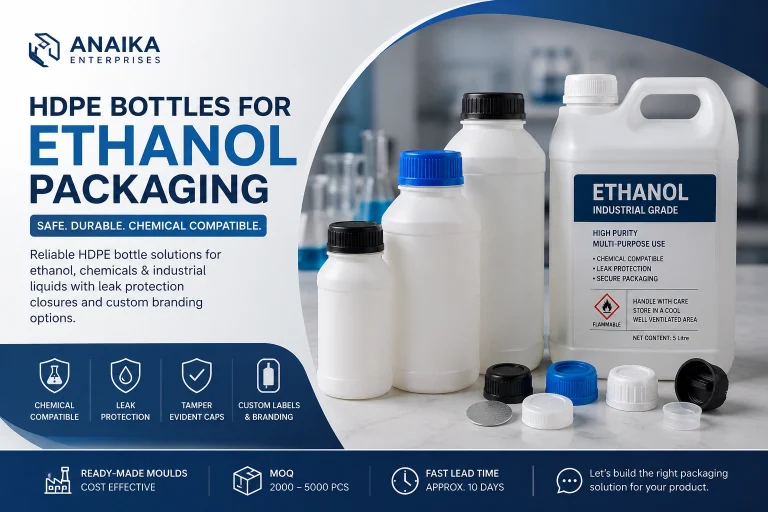
Practical Packaging Guidance for Ethanol, Chemical & Industrial Liquid Products. Selecting the right HDPE bottle for ethanol packaging involves more than choosing a bottle size.
A Short Visuals of the Bottles
Why HDPE Bottles Are Commonly Used for Ethanol Packaging?
HDPE bottles are widely used for ethanol and industrial liquid products because they offer a balance between chemical resistance, durability, weight, and cost.
Some common questions buyers ask include:
Why use HDPE instead of PET?
HDPE generally offers better chemical resistance for many industrial and chemical products and is less prone to stress cracking under certain applications.
HDPE vs PP – Which is better?
The answer depends on the product formulation, filling conditions, closure requirements, and intended usage. Both materials have advantages depending on the application.
Is HDPE suitable for acids and chemicals?
Many chemical products are packaged successfully in HDPE containers. However, chemical compatibility should always be validated by the product owner through stability and shelf-life testing before commercial use.
Will HDPE bottles crack during transport?
Properly specified HDPE bottles are highly impact-resistant and are commonly used in industrial distribution environments. Final performance depends on bottle design, wall thickness, filling conditions, and secondary packaging.
Choosing the Right Bottle Shape & Closure System
Bottle selection should be driven by usability, filling requirements, storage conditions, and product positioning.
Common bottle formats include:
Round Bottles
Suitable for:
- Ethanol products
- Cleaning products
- Laboratory applications
- Industrial liquids
Square Bottles
Suitable for:
- Improved storage efficiency
- Better shelf utilization
- Commercial packaging applications
Handle Bottles
Suitable for:
- Higher volume products
- Industrial applications
- Frequent product handling
Jerry Cans
Suitable for:
- Bulk liquid packaging
- Industrial chemicals
- Commercial distribution
Closure options may include:
- Screw Caps
- Tamper Evident Caps
- Child Resistant Caps (CRC)
- Plug Seal Systems
- Flip Top Closures (where suitable)
The correct closure depends on leak prevention requirements, user safety considerations, filling process, and product application.
Sealing, Leakage Prevention & Product Security
Leak prevention is often more dependent on closure selection than bottle selection.
Depending on the application, packaging systems may include:
- Induction Sealing
- Wad Seals
- Plug Seals
- Tamper Evident Closures
- CRC Closures
Questions we commonly evaluate include:
- Can induction sealing be used?
- Is tamper evidence required?
- Is child resistance necessary?
- What level of leak protection is required?
- Will the product be shipped through courier networks?
These factors help determine the most suitable closure system before production.
Chemical & Product Compatibility Considerations
Selecting the right bottle is only one part of the packaging decision.
The compatibility between the product formulation and packaging material should always be evaluated before commercial production.
Factors commonly reviewed include:
- Product formulation
- Chemical composition
- Product concentration
- Storage conditions
- Shelf-life requirements
- Filling temperature
- Closure compatibility
Questions often discussed during evaluation include:
Is HDPE suitable for ethanol?
HDPE is commonly used for ethanol packaging applications. However, product compatibility should always be validated through product-specific testing.
Is HDPE suitable for acids?
Many acids and chemical products are packaged in HDPE containers, but compatibility varies depending on the chemical composition and concentration.
Can the same bottle be used for different products?
Not always. Product compatibility, closure selection, labeling requirements, and shelf-life expectations should be reviewed before selecting a packaging system.
At Anaika Enterprises, bottle selection is evaluated alongside product requirements to help businesses identify suitable packaging options before production.
Branding & Product Decoration Options
Beyond functionality, packaging also influences product presentation and market perception.
Common decoration options include:
Pressure Sensitive Labels
Suitable for:
- General chemical products
- Industrial applications
- Short-to-medium production runs
Digital Labels
Suitable for:
- Multiple SKUs
- Lower quantity launches
- Faster artwork changes
Chemical Resistant Labels
Suitable for:
- Industrial products
- Solvents
- Chemical formulations
- Outdoor exposure
Shrink Sleeves
Suitable for:
- Full bottle branding
- Improved shelf presence
- Premium visual impact
Screen Printing
Suitable for:
- Long production runs
- Durable branding requirements
- Direct bottle decoration
The most suitable branding method depends on the product environment, expected exposure conditions, budget, and visual objectives.
Existing Bottle Moulds vs New Bottle Development
For most businesses, existing bottle moulds provide the most practical starting point.
Benefits include:
- Lower investment
- Faster sampling
- Faster production
- Reduced development risk
- Availability across multiple bottle sizes
Typical starting quantities often range from approximately:
2,000 – 5,000 bottles
Custom bottle development is possible but typically involves significantly higher tooling investment, development timelines, and project complexity.
For many products, using an existing bottle design and investing in branding and labeling provides a faster route to market.
Typical Lead Time
Once bottle selection, closure selection, artwork, and purchase order confirmation are complete, standard production timelines are typically around:
Approximately 10 Working Days
Actual lead time depends on bottle availability, quantity, decoration requirements, and closure configuration.
Completing the Packaging System
Looking for HDPE Bottles for Ethanol or Chemical Products?
Share your:
- Product type
- Filling quantity
- Expected order volume
- Closure requirements
- Branding requirements
Want to get your existing packaging reviewed?
Bottle selection is only one part of the packaging system.
Depending on the application, businesses may also require:
Product Labels
Folding Cartons
Corrugated Shipping Cartons
Combo Packaging Systems
Export Packaging Solutions