Sweet & Mithai Packaging Boxes
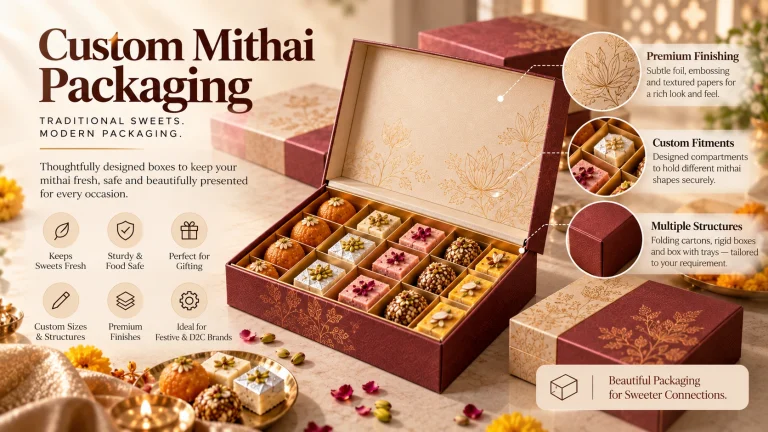
Custom mithai packaging developed around your sweets, assortment, quantity, presentation, and brand positioning.
Indian sweets are no longer limited to the traditional neighbourhood mithai shop.
Today, a mithai box could be for a premium D2C sweet brand, a sugar-free product line, a festive collection, a wedding, a corporate gift, a premium retail product, or a traditional sweet shop upgrading its presentation.
And each of those requirements can call for a different packaging approach.
At Anaika Enterprises, we help businesses develop sweet and mithai packaging around the actual product — considering the size and shape of the sweets, number of pieces, internal arrangement, presentation, quantity, and production requirements.
You bring us the sweets. We help you work out the packaging.
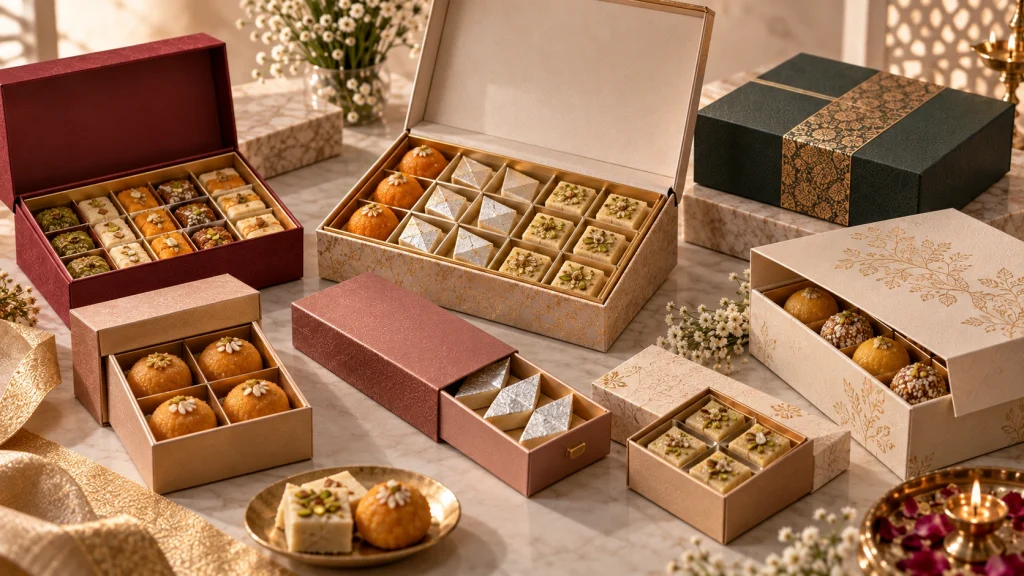
Mithai Packaging Is No Longer Just About Putting Sweets in a Box
A traditional mithai box may look simple.
But once you’re developing packaging for a branded product, several questions come into play:
- What type of sweet is being packed?
- How many pieces go into each box?
- Are the pieces uniform in size?
- Do different sweets need separate compartments?
- How much internal clearance is required?
- Does the box need a food-contact liner or inner packaging?
- Is the product being sold retail, D2C or primarily for gifting?
- Does the packaging need to survive delivery?
- Is the box meant to be functional or premium?
- What quantity is required?
- How much finishing makes commercial sense?
The box should be developed around the product and the occasion — not simply selected from a catalogue.
Want to get your existing product packaging reviewed?
Different Mithai Products Can Need Different Packaging
Laddoo Boxes
Laddoos can vary significantly in diameter, height, and weight.
A box for six uniform laddoos may need a very different internal arrangement from a premium assorted collection.
Barfi & Kaju Katli Boxes
These products are often arranged in rows or layers, making internal dimensions, dividers, and presentation important.
Assorted Mithai Boxes
When several types of sweets are packed together, the internal layout becomes much more important.
Different shapes and sizes may require:
Compartments → dividers → trays → inserts
rather than simply increasing the size of the outer box.
Premium Mithai Gift Boxes
For premium gifting, the packaging becomes part of the product experience.
Rigid boxes, trays, sleeves, custom inserts, foiling, and embossing can all be evaluated depending on the requirement.
Sugar-Free & Modern Mithai Brands
Newer sweet brands may position themselves around sugar-free, reduced-sugar, alternative-sweetener or health-conscious offerings.
The packaging therefore often needs to look less like a traditional mithai box and more like a modern packaged-food brand.
This creates opportunities for contemporary structures, strong branding, and retail/D2C-friendly presentation.
From Traditional Mithai to Premium D2C Gifting
This is an important shift in the category.
Premium mithai brands are increasingly treating packaging as part of the overall customer experience, particularly around gifting. Recent industry coverage describes premiumisation, curated assortments, and packaging/presentation as increasingly important to the category.
That creates several different packaging opportunities.
Traditional Mithai Retail
Functional, practical packaging for regular retail sales.
Premium Mithai
More emphasis on presentation, branding, and finishing.
D2C Sweet Brands
Packaging needs to work with the brand identity and potentially withstand courier handling.
Festive Collections
Diwali, Raksha Bandhan, Holi, and other seasonal launches may require limited-edition packaging or new formats.
Wedding & Event Gifting
Packaging can be customised around the event, quantity, and gifting presentation.
Corporate Gifting
The box may need to accommodate a combination of sweets, cards, or other products and present them as a complete gift.
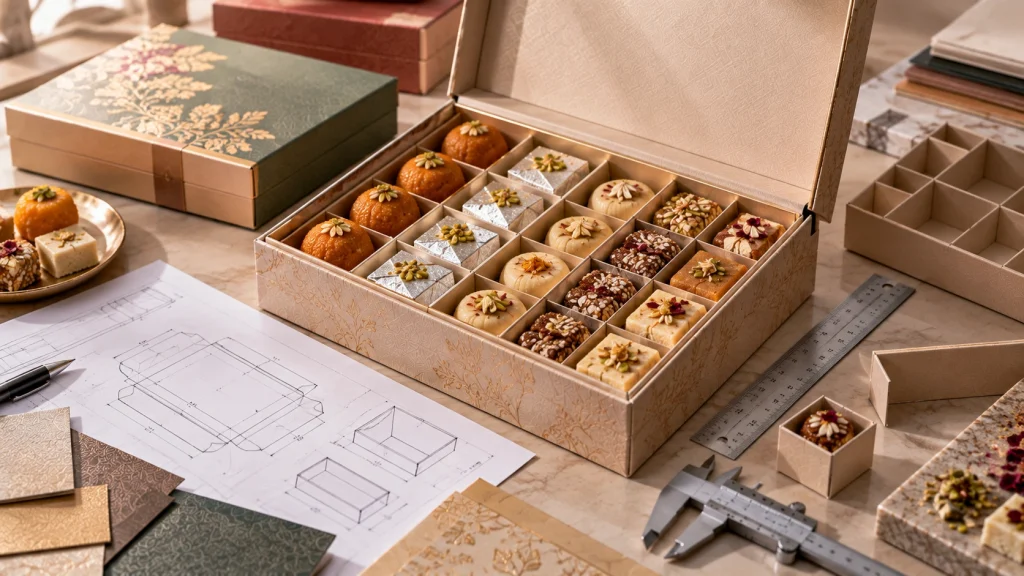
Premium Mithai Boxes: When the Packaging Becomes Part of the Gift
For a premium mithai brand, the box doesn’t necessarily need to be extravagant.
It needs to feel intentional.
Depending on the requirement, we can explore:
- Premium paperboard
- Rigid boxes
- Custom trays
- Internal compartments
- Printed sleeves
- Special papers
- Foiling
- Embossing
- Debossing
- Spot UV
- Die-cut elements
- Custom branding
- Premium printed interiors
A beautifully finished box can be particularly relevant when the mithai itself is being positioned as a premium gift rather than simply a food product.
But there is an important commercial consideration:
More finishing does not automatically mean better packaging.
The structure, quantity, production method, and target selling price all need to make sense together.
What About the Inside of the Mithai Box?
This is where packaging development becomes particularly important.
The outer box may be attractive, but the actual sweets still need to be packed properly.
Depending on the application, the packaging may need:
Individual Compartments
Useful when different sweets need to remain separated.
Custom Trays
Can provide a defined arrangement for premium assortments.
Dividers
Useful for organising multiple sweet varieties.
Inner Liners / Food-Contact Components
Where required, the appropriate inner packaging should be considered separately based on the food-contact application and material requirements.
Custom Fitment
Useful when the shape, size, or arrangement of the sweets is unusual.
The internal arrangement should be designed around the sweets you’re actually selling.
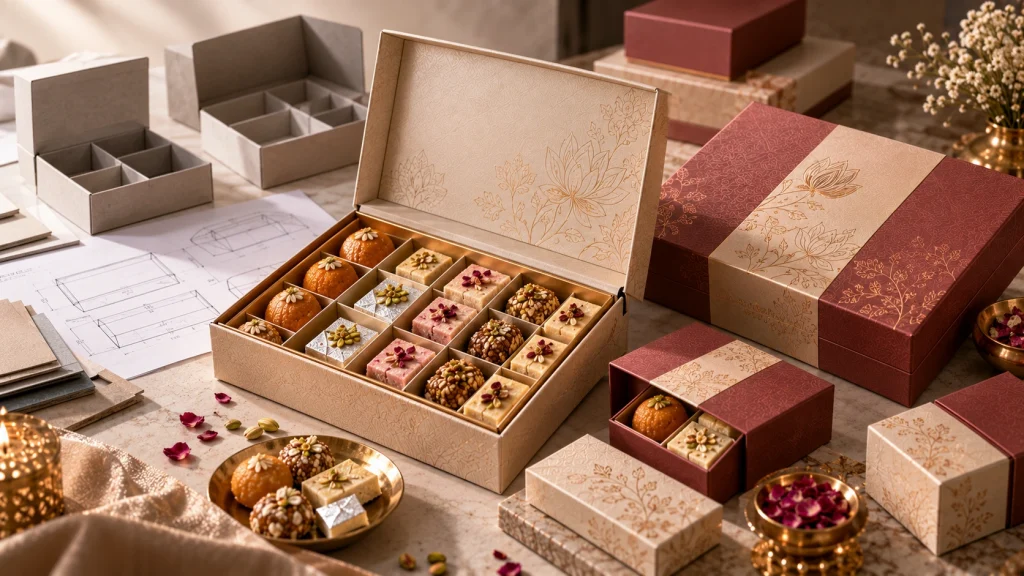
Quick Sampling Before Large Production
For new mithai brands and new packaging concepts, sampling can be particularly useful.
Instead of committing immediately to a large quantity, the development process can help answer questions such as:
Do the sweets fit correctly?
Does the arrangement look premium?
Is the box unnecessarily large?
Does the divider work?
Is the structure strong enough?
Does the packaging communicate the brand positioning?
Does the proposed construction make sense for the intended quantity?
A physical sample can then be evaluated before moving into production.
This is particularly relevant for new brands, new SKUs, festive collections and premium gifting concepts.
Low & Medium MOQ Mithai Packaging
You don’t necessarily need to be an established mithai chain to develop custom packaging.
The requirement could come from:
- A new D2C mithai brand
- A homegrown premium sweet brand
- A new sugar-free range
- A boutique mithai shop
- A festive product launch
- A wedding gifting collection
- A corporate gifting programme
- A new premium SKU
At lower quantities, production economics can change because setup, tooling, printing and material costs are spread across fewer pieces.
So the objective isn’t simply:
“Give me the lowest MOQ.”
It is:
“What packaging structure and production method make sense for the quantity I actually need?”
That distinction can make a significant difference to the final packaging cost.
Can the Packaging Start Small and Scale Later?
Ideally, yes — where the structure and production method allow it.
A new brand may initially need 500–2,000 boxes while testing a product.
Later, the same product could require much larger production quantities.
The most economical manufacturing approach may change as volume increases.
Therefore, during development, it can be useful to consider:
Today’s quantity + tomorrow’s scale
rather than designing the packaging completely independently of future production.
How Anaika Works With a Mithai Packaging Requirement
You don’t need to arrive with a packaging specification.
1. Tell Us About the Sweets
Share the type of mithai, dimensions, approximate weight, and number of pieces.
2. Explain the Application
Retail? D2C? Festive gifting? Wedding? Corporate gifting?
3. We Understand the Arrangement
How many sweets? One variety or multiple varieties? Do they need separation?
4. Work Through the Structure
Box construction, material, tray, insert, divider, and presentation can be evaluated.
5. Develop a Sample
Where required, a physical prototype can be developed for fitment and presentation.
6. Refine the Packaging
The structure, artwork, finishing, and production approach can be adjusted based on the approved direction.
7. Move Into Production
Once the relevant specifications and approvals are finalized, production can proceed.
You don’t have to figure everything out before approaching us.
A Mithai Box Should Make Commercial Sense Too
Suppose a brand is selling a ₹500 mithai gift pack.
A heavily finished rigid box might look beautiful — but if the packaging cost makes the product commercially difficult to sell, it may not be the right solution.
On the other hand, a premium ₹2,000–₹3,000 gifting product may justify a significantly more elaborate presentation.
So we look at:
Product value → Quantity → Target customer → Occasion → Packaging structure → Finishing → Production economics
The objective is not to make the most expensive box.
It is to develop the right box for the product.
Launching a new product?
Related Packaging Solutions
Frequently Asked Questions
Can you make custom mithai boxes?
Yes. Sweet and mithai packaging can be developed around the type of sweets, dimensions, quantity, arrangement, presentation, and production requirements.
Can you make boxes for different types of mithai?
Yes. Packaging can be developed for laddoos, barfi, kaju katli, peda, assorted sweets, and other products based on their dimensions and packing arrangement.
Can you make boxes for assorted mithai?
Yes. Assorted mithai boxes can be developed with suitable internal arrangements, dividers, trays, or inserts depending on the number and type of sweets being packed.
Can mithai boxes have premium finishing?
Yes. Depending on the structure and production method, premium packaging can incorporate finishes such as foiling, embossing, debossing, specialty papers, and other decorative treatments.
Can you develop packaging for a new D2C mithai brand?
Yes. Packaging can be developed around the brand’s product range, quantities, presentation requirements, and intended sales channel.
Can you make sugar-free mithai packaging?
Yes. Packaging can be developed for sugar-free and other specialised mithai products based on the product dimensions, quantity, packaging arrangement, and branding requirements.
Can I get mithai boxes in low quantities?
Selected mithai packaging applications can be developed and manufactured in low or medium quantities. The practical MOQ depends on the structure, material, printing, finishing, and production process.
Can I get a sample before ordering a larger quantity?
Where required, a physical sample can be developed to evaluate the box structure, dimensions, internal arrangement, and product fitment before production.
What if I don’t know which mithai box structure I need?
That’s exactly where packaging development can help. Share your sweets, dimensions, quantity, and intended application, and suitable packaging structures can be evaluated.
Can you help with premium corporate or festive mithai packaging?
Yes. Packaging can be developed for festive, wedding, and corporate gifting requirements, including custom dimensions, internal arrangements, and premium printing or finishing where appropriate.